
Create a lifecycle marketing strategy by mapping customer needs, segmenting your audience, and building campaigns around measurable actions. Use awareness, consideration, conversion, and retention to plan your messages. For ecommerce teams, start with one workflow and measure purchases, retention, and customer feedback before expanding.
What is lifecycle marketing?
Lifecycle marketing is a strategy for engaging customers with personalized content based on where they are in the customer journey.
Customer needs evolve as they move through each stage. And it’s not always a linear path. Some customers move back and forth between different stages. Others spend more time in one stage than others. Some drop off before ever turning into customers or repeat buyers.
An effective lifecycle marketing strategy tracks relevant customer interactions. It then responds with tailored content that speaks to the customer’s needs. A new subscriber might need product guidance. A recent buyer needs delivery information and help using the product. An inactive customer may need a reason to return.
In Salesforce’s 2022 State of the Connected Customer research, 88% of customers said a company’s experience mattered as much as its products or services. The global survey covered over 13,000 consumers and nearly 4,000 business buyers across 29 countries.
Lifecycle marketing connects that experience to specific actions, such as completing a purchase or returning for a refill. The aim is to increase customer lifetime value and make acquisition spending pay back through profitable relationships. Track whether your campaigns deliver those results; personalized messages alone don’t guarantee retention.
Customer lifecycle marketing campaigns aim to increase repeat purchase rate, reduce the time between purchases, and boost customer retention. The strategy gives you a reason to keep helping customers after the first sale.
Step 1: Set a goal and define your ideal customer profile
Build your lifecycle marketing strategy around one measurable goal and an ideal customer profile based on customers who get value from your products.
Effective lifecycle marketing starts at the very top with the type of customers you attract. Analyze your customer records to identify your VIP customers. Rank customers by lifetime value and profitability to identify valuable customer segments. Account for returns and discounts when evaluating those relationships.
Complement that data with qualitative feedback. Why did the customers buy the product? What pain point does your product address? What makes them reorder, and what nearly stopped them from buying? Use firmographic data when you sell to businesses; for consumer brands, focus on relevant needs and buying behavior.
Use that data to create your ideal customer profile (ICP). Every department in your organization should operate with that ICP in mind. Treat the profile as a starting point to test as you learn more about your audience.
Then choose a problem to solve. For example, if first-time buyers rarely return, focus on the second purchase before adding more acquisition campaigns. Record the current repeat purchase rate and choose a review period that fits the product’s buying cycle.
Score every trait used in creating your ICP with weighted points. The most important buying signals should have the highest scores. A product inquiry and a repeat purchase should not automatically carry the same score as an email click.
When customers enter your funnel, use the scores to triage and prioritize them accordingly. Review whether high-scoring prospects actually become valuable customers before increasing the resources you spend on them.
Step 2: Map the customer journey and choose your first campaign
Map your lifecycle marketing strategy around customer actions, then choose the campaign that addresses a clear friction point in the journey.
Analyze the customer journey to see how customers interact with your brand. Mapping shows key touchpoints as well as friction points that must be resolved. Include every customer touchpoint you can identify, from ads and signup forms to checkout, delivery, and support. Combine store analytics with interviews and support questions.
Use a four-stage model to organize the work: awareness, consideration, conversion, and retention. These are planning categories, not a path every person follows in order. Define the event that moves someone into or out of a campaign.
| Lifecycle stage | Example campaign | Outcome to track |
|---|---|---|
| Awareness | Signup offer and welcome email | Visitor-to-subscriber conversion |
| Consideration | Product guidance and comparison content | Qualified product visits and inquiries |
| Conversion | Cart reminder and checkout reassurance | Completed purchases |
| Retention | Product education and replenishment reminder | Repeat purchase rate |
Start where the customer need, available data, and business goal overlap. If shoppers add products to a cart but leave, check delivery costs and checkout usability before building a reminder sequence. An email won’t fix a broken checkout.
Write a short campaign brief: audience, entry event, customer need, message, channel, exit event, owner, and success metric. That brief gives your team something concrete to build and review.
Keep the first workflow manageable. A welcome sequence or post-purchase guide gives you a way to test your data and handoffs before connecting more campaigns.
Step 3: Connect your customer data and choose lifecycle marketing tools
A lifecycle marketing strategy needs reliable customer records, automation software, and reporting that connects campaigns to customer actions.
Customer relationship management software
A CRM stores customer data and helps track customers as they move through the lifecycle stages. It shows customers’ interactions, purchase history, engagement behavior, and other attributes. Effective lifecycle marketing relies on accurate first-party data. It helps you understand where each customer is in their journey and what resonates with them.
Customer records also support advanced customer segmentation. Use the data to group customers by their purchase history, spending habits, product interests, and engagement levels. A smaller store may start with ecommerce records and contact profiles; a separate CRM becomes useful when sales and support need shared context.
Decide which system owns each field. Use a consistent customer identifier and confirm which events sync, how often they update, and how duplicate records are handled. Store channel preferences alongside the customer record.
Marketing automation software
A CRM gives you the data you need to understand your customers. Marketing automation software helps you put that data to good use. An automation solution lets you create workflows that respond to specific customer actions, such as a signup, abandoned cart, or completed purchase.
GetResponse is one example of a lifecycle marketing automation tool. Its GetResponse integrations directory lists HubSpot and Salesforce connections through Outfunnel Sync. Check the connector’s field mapping and update behavior before using CRM changes as campaign triggers.
Choose tools by the data and workflows you need, rather than the length of the feature list. Confirm that your store’s purchase events, product data, and unsubscribe preferences reach the systems that send messages.
For reporting, look for campaign engagement and purchase data that you can compare over time. Revenue reporting helps evaluate sales; profitability also needs product costs, returns, discounts, and campaign spend.
Step 4: Build workflows and coordinate the customer experience
Build lifecycle marketing workflows with a clear entry event, relevant messages, exit conditions, and an owner for customer handoffs.
A prospect joins your email list? A welcome email series starts. A customer leaves a cart? A reminder can follow. A purchase should change what happens next, so someone who has already ordered stops receiving prompts to complete the same order.
- Entry: Define the event and eligible audience, including channel preferences.
- Message: Address one customer need and give the reader a clear next action.
- Timing: Match the delay to the task, delivery status, or normal buying cycle.
- Exit: Stop or change the sequence after a purchase, opt-out, or other event that makes the message irrelevant.
- Handoff: Assign someone to act when a reply or support request needs human help.
Lifecycle marketing is about personalizing the customer experience at every touchpoint. Sales, marketing, customer support, customer success, and product teams need to understand the customer journey and the specific role they play in it. Share customer insights so each team can act on what the others have learned.
Customers engage with your brand across various channels. Your lifecycle marketing strategy should identify these channels and provide a consistent experience throughout. The tone, offer, positioning, and visual branding must remain consistent. Check each channel’s permissions and available tools before adding it to a sequence.
Audit your lifecycle automation workflows to ensure there are no overlapping campaigns. Give order updates and unresolved support issues priority over promotional messages. Keep eligibility and purchase status in sync so different teams don’t send conflicting offers.
Step 5: Test and measure your lifecycle marketing strategy
Test your lifecycle marketing strategy against a baseline, using stage-specific outcomes and checks for irrelevant or excessive messages.
Before launching, use test contacts to check the trigger, segment, message, and exit conditions. Confirm that product links work and that a second purchase removes the customer from a first-purchase promotion. Check mobile layouts and what happens when a field is empty.
Choose the main outcome before changing the campaign. Welcome campaigns might focus on the first purchase. Replenishment campaigns need repeat orders and time between purchases. A loyalty campaign should be judged by participation and repeat buying, not just clicks.
- Awareness: visitor-to-subscriber conversion and cost per qualified lead.
- Consideration: product-page visits, useful replies, and qualified inquiries.
- Conversion: completed purchases, conversion rate, and campaign cost per order.
- Retention: repeat purchase rate, time to the next order, and retention by customer group.
- Message quality: unsubscribes, complaints, and support feedback.
Compare similar customer groups over the same period. Where practical, use a control group that doesn’t receive the new campaign to estimate whether it changes buying behavior. Revenue attributed to an email does not, by itself, prove the email caused the purchase.
Change one meaningful element at a time, such as the offer, timing, or product guidance. Review what customers do after the click. Keep the useful campaigns, revise weak ones, and stop sequences that create more confusion than value.
Awareness example: Capture interest with a useful offer
Lifecycle marketing at the awareness stage helps potential customers discover your brand and gives interested visitors a reason to stay in touch.
Your objective at the awareness stage is to attract and capture the attention of potential customers. You also want to convert interested website visitors into leads. Lead capture forms give those visitors a way to stay in touch.
Choose the audience and message before expanding reach. The same customer profile should guide a brand’s landing pages and its paid advertising, so the offer people see after clicking matches the original promise.
Huel uses a first-order discount as an incentive for visitors to share their contact details. The screenshot makes the minimum order value visible alongside the offer, so the reader can see the condition before signing up.
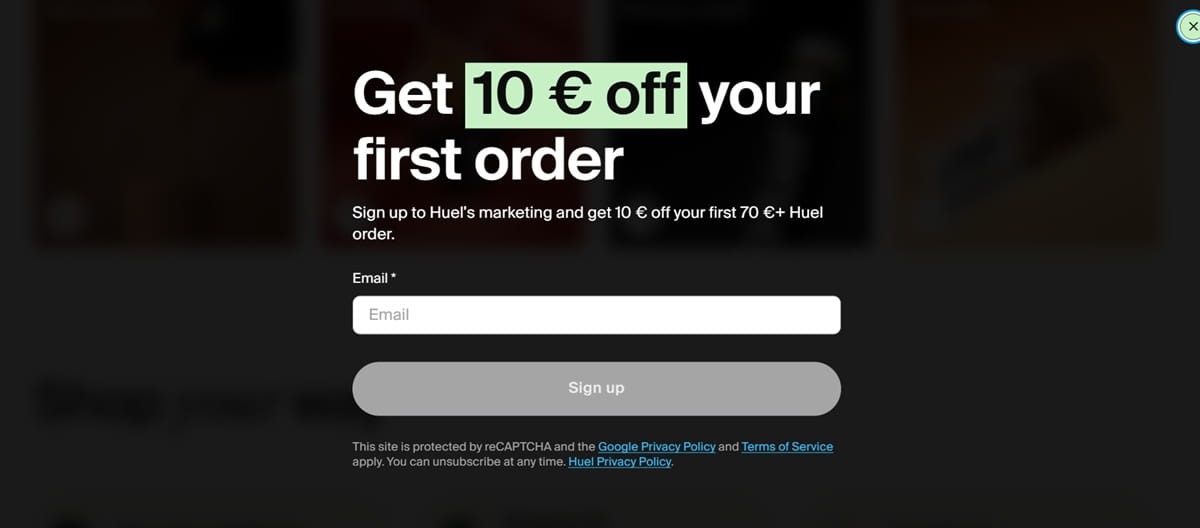
The contact details allow the brand to use a welcome email series to nurture the relationship. Your welcome campaign should deliver what the form promised and help the new subscriber choose a next step.
A discount is one option. Product guidance, a useful resource, or a relevant update may be a better fit for your audience. Track whether the subscribers you attract become customers, rather than judging the form by signup volume alone.
Consideration example: Help prospects choose a product
Lifecycle marketing at the consideration stage answers product questions and helps interested prospects decide whether an offer fits their needs.
Potential customers at this stage are aware of your brand and its offerings. They may still be comparing different brands. Marketing content like customer testimonials and reviews, product demos, case studies, and product comparisons can address their doubts. Use evidence you can substantiate, and make it easy to ask a question.
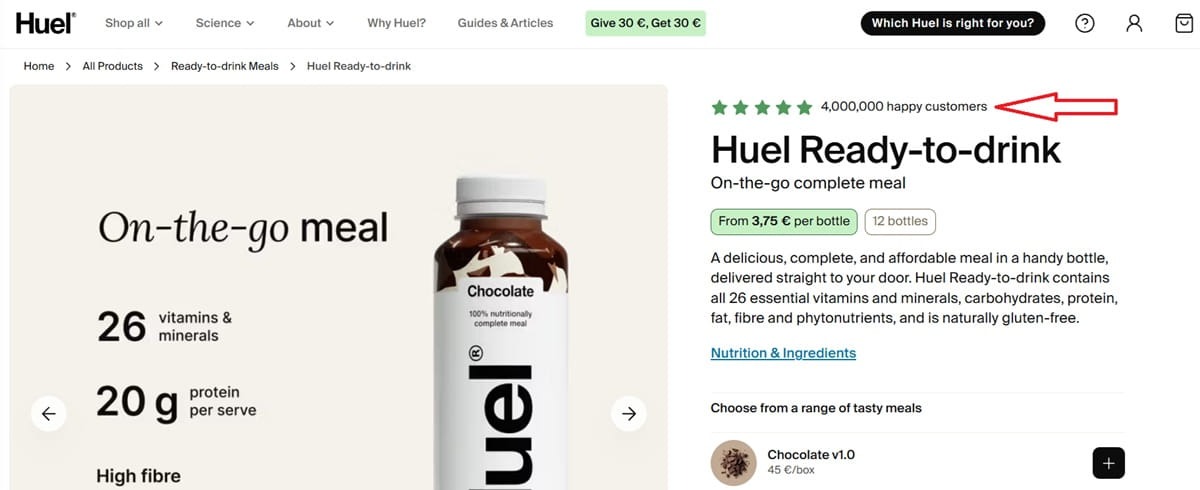
Huel’s Ready-to-drink product page places a customer-count claim and star icons above the product name. The positioning makes social proof visible while the visitor evaluates the product.
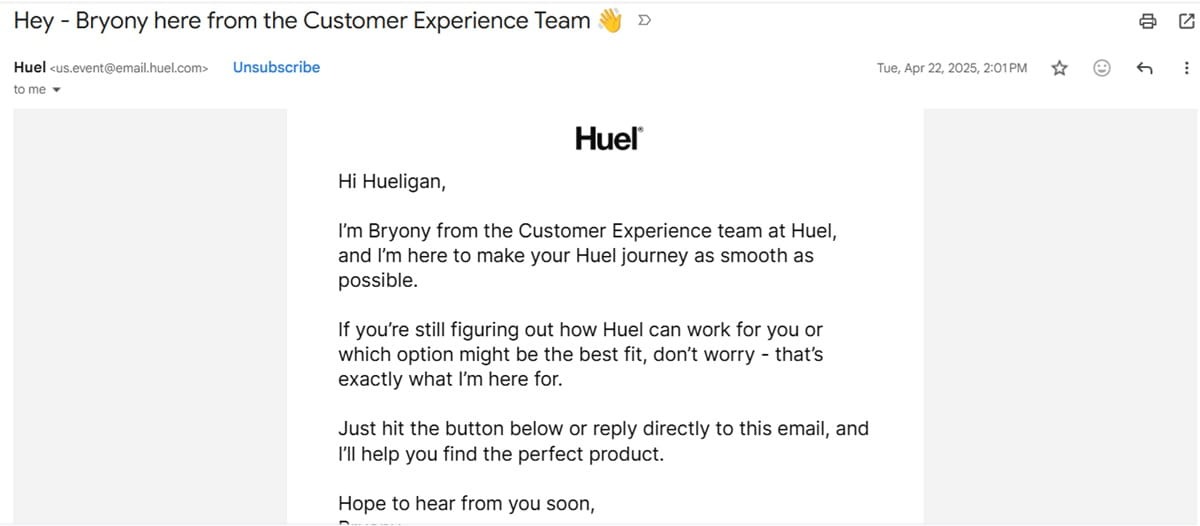
Then there are the lead nurturing emails. In addition to promotional emails, Huel also sends educational emails. One introduces someone from the customer experience team to help potential customers get started on their Huel journey. The reader can reply for product guidance.
Follow-up emails help potential customers see how Huel’s products could fit into their current lifestyles. This gives the reader a more specific starting point than a link to the entire catalog.
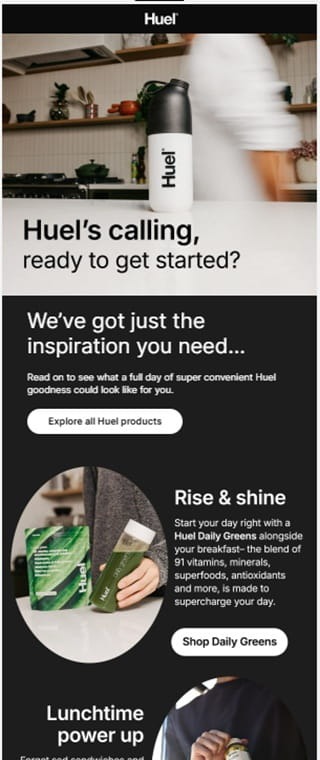
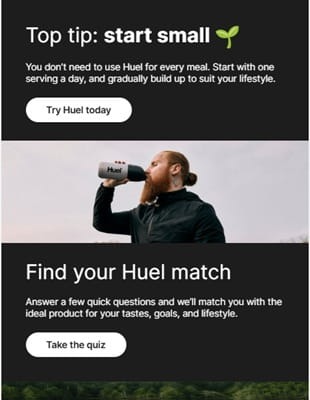
Another email tells customers they don’t need to use Huel for every meal. They can start small. There’s also a link to a quiz customers can use to find products for their goals. The message breaks the decision into a manageable next step.
Use your own customer questions to plan this content. If prospects keep asking the same question, answer it in the follow-up and on the product page. Track useful replies, product visits, and purchases to learn which information helps people decide.
Conversion example: Remove obstacles to the first purchase
Lifecycle marketing at the conversion stage reinforces the offer and removes doubts that prevent an interested prospect from completing a purchase.
Marketing campaigns at the conversion stage should reinforce your value proposition and address any lingering doubts. Emails highlighting customer reviews, return policies, and guarantees your business actually offers can answer practical questions. Keep those details consistent between the campaign and checkout. A limited-time offer should have a real deadline and clearly stated conditions.
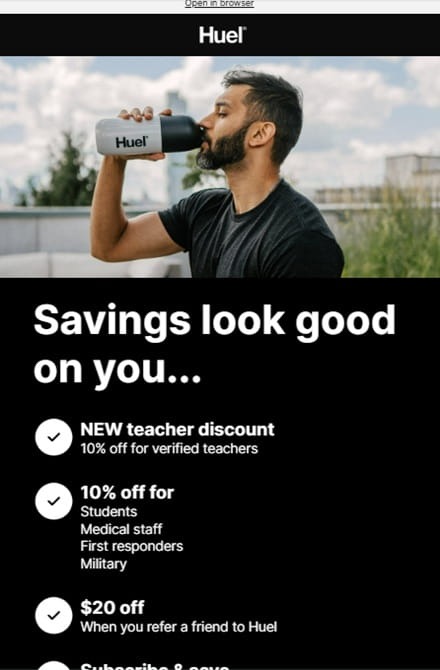
Huel’s email below groups offers by eligibility, including teacher and student discounts, alongside a referral reward. The message helps readers find the benefits that apply to them.
For your own campaign, show who qualifies, what the offer applies to, and any minimum spend before the customer reaches checkout. Don’t send the same incentive to everyone simply because they appear in a conversion segment.
Make sure to eliminate friction in the conversion process. Minimize checkout steps and form fields, add a guest checkout option where practical, and offer payment methods your customers use. Show delivery charges early so shoppers can assess the full cost.
Still, not every prospect who browses and adds items to a cart will convert. Use browse reminders and cart abandonment campaigns where your tracking and channel permissions support them. Stop reminders once the customer completes the relevant order.
Review the reasons for abandonment as well as the campaign results. A reminder may bring someone back, but confusing costs or missing product information still need fixing.
Retention example: Help customers get value and buy again
Lifecycle marketing at the retention stage helps customers use their purchases, find relevant products, and decide whether to buy again.
Retention supports sustainable growth for your business when repeat orders are profitable. Your objective at the retention stage is to keep customers engaged and encourage repeat purchases. This requires strategic post-purchase campaigns. Include both educational and promotional content.
Educational content helps customers get more value from their purchases. Send emails teaching customers how to use the product effectively. Match the guidance to what they bought, and give them a way to ask for help.
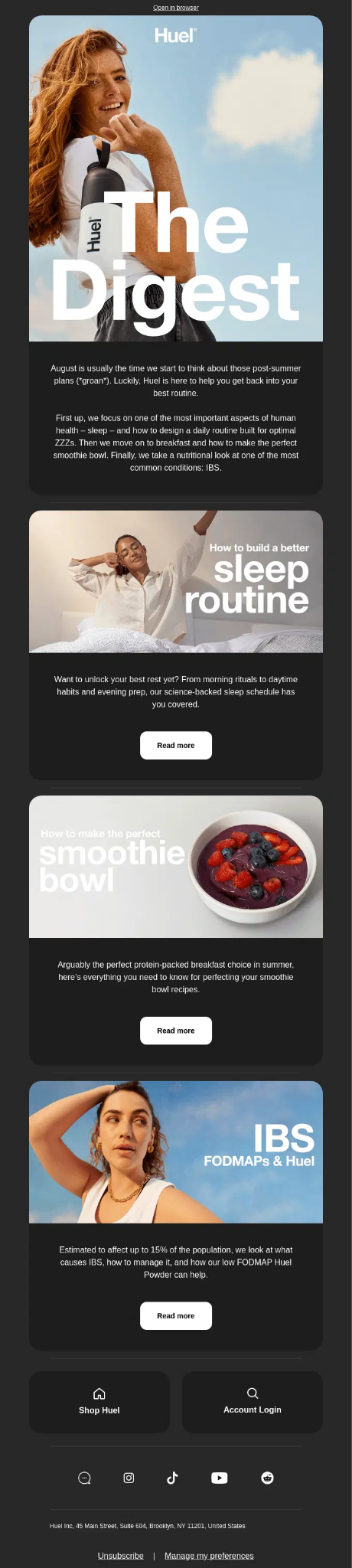
Huel keeps customers informed through The Digest newsletter. The campaign below includes an article about improving your sleep routine, alongside other reading. It shows how a brand can keep in touch without making every message a sales offer.
Cross-selling and upselling relevant products can support repeat purchases. Replenishment reminders based on how often customers need refills also help. Time reminders around how customers use the product, rather than applying the same delay to every category.
Promote your customer loyalty and referral programs at the retention stage. Educate your customers about the perks of joining the loyalty program. Make useful benefits visible, such as early access or free shipping where your program offers them.
Our 2026 customer loyalty research found that 67.3% of consumer respondents felt brands valued new customers more than existing ones. Meanwhile, 69% of brands reported splitting their budget evenly between acquisition and retention. The study covered 2,400 consumers and 600 direct-to-consumer brands across six markets in health, beauty, and wellness.
Market the benefits of sticking with your brand so customers can see what their loyalty earns. But marketing alone is not enough. Responsive support, reliable delivery, and a product that meets expectations are part of the experience, too.
Additionally, collect customer feedback regularly. Use the feedback to improve customer experience and shape product development. Invite satisfied customers to share honest reviews or recommend your brand through a referral program, then measure participation and completed referrals.
Using GetResponse for lifecycle marketing automation
GetResponse lifecycle automation software supports behavior-based workflows, contact segmentation, and prebuilt templates for lifecycle marketing campaigns.
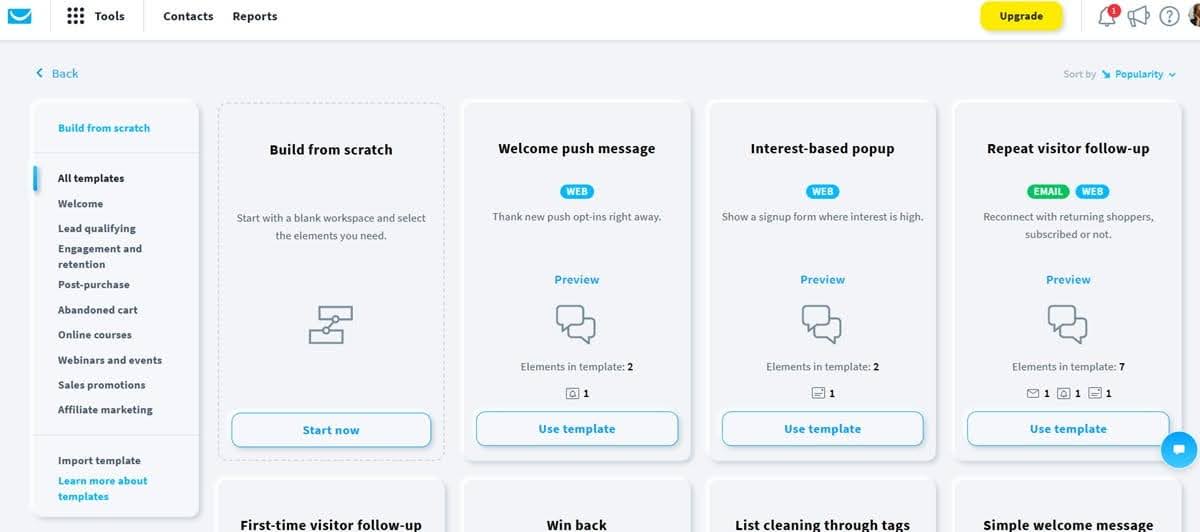
Start with the workflow that matches your campaign brief. Set the audience, messages, conditions, and timing, then test the path before enrolling customers. The template library includes categories for welcome, engagement and retention, post-purchase, and abandoned cart campaigns.
GetResponse supports store connections such as Shopify, Magento, BigCommerce, and WooCommerce through its GetResponse ecommerce integrations. Confirm the data available from your particular connection before choosing triggers.
You can use purchase history for relevant product recommendations and contact tags or scores for segmentation. The workflow screenshot below uses contact-score thresholds to select an email. Define what earns points before treating a score as a sign of buying intent.
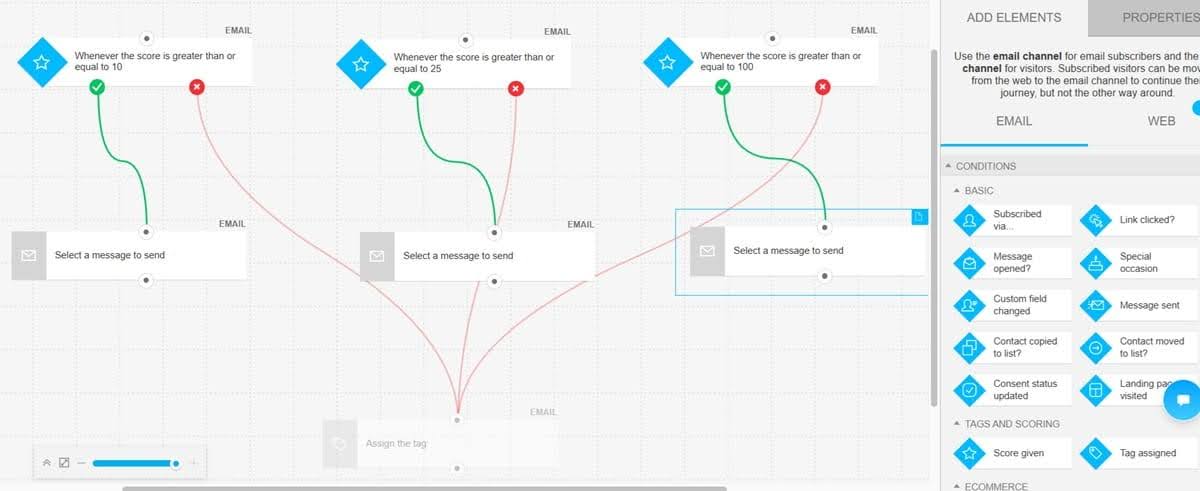
Feature availability depends on the plan. Starter currently includes one custom workflow; Marketer includes unlimited workflows, abandoned cart recovery, and web push notifications. Review GetResponse plans and features for your requirements. SMS automation and AI recommendations are listed on Enterprise.
Use reporting, including revenue attribution, to review campaign results. Combine attributed sales with campaign costs and customer feedback when deciding what to keep.
Set up a free account to explore GetResponse and test your first lifecycle workflow. No credit card required to start the trial.
Lifecycle marketing FAQs
A lifecycle marketing strategy connects customer needs, campaign triggers, and measurable outcomes across awareness, consideration, conversion, and retention.
What is lifecycle marketing?
Lifecycle marketing is a strategy for engaging people with relevant content and offers based on their stage in the customer journey. It uses customer data to guide communication before and after a purchase, including welcome messages, product guidance, and retention campaigns.
What are the 4 stages of the lifecycle in marketing?
The four stages in this lifecycle marketing model are awareness, consideration, conversion, and retention. Awareness introduces the brand, consideration helps people evaluate products, conversion supports a purchase, and retention encourages an ongoing relationship. Customers can move between stages, pause, or leave.
What tools are used for lifecycle marketing?
Lifecycle marketing uses customer records, marketing automation, and reporting tools. A CRM or connected ecommerce platform supplies customer data, while an automation tool such as GetResponse uses events and conditions to send relevant messages. The connections and features you need depend on your campaigns and plan.
How do you create a lifecycle marketing strategy?
Create a lifecycle marketing strategy by setting a measurable goal, defining your audience, mapping customer touchpoints, and connecting the data needed for each campaign. Build one workflow with clear entry and exit conditions, test it, and compare results with your starting point before expanding.
How do you measure lifecycle marketing success?
Measure lifecycle marketing success with metrics matched to the campaign’s goal, such as purchase conversion, repeat purchase rate, retention, or time to the next order. Review costs, unsubscribes, complaints, and customer feedback alongside attributed revenue. Compare similar customer groups over the same period.
