
Customer loyalty has moved from a marketing tactic to a board-level priority.
But what does loyalty actually look like in 2026 – from both sides of the relationship?
To answer that question, we surveyed 2,400 consumers who regularly purchase health, beauty, and wellness products and 600 direct-to-consumer brands operating across the same categories and markets.
In total, the research captures 3,000 voices across six countries, offering a side-by-side view of how customers and brands experience loyalty today.
The goal was simple:
- Understand what keeps customers loyal
- Identify where brands are investing
- Reveal where expectations align and where they don’t
What we found is both encouraging and revealing.
Loyalty is nearly universal in theory, but execution is far less consistent in practice.
Nearly every brand we surveyed (98%+) says customer loyalty will be critical to their success over the next two to three years. Retention slightly outranks acquisition as a growth priority, particularly among larger brands.
At the same time, customers are showing strong loyalty behaviors:
- 64% repurchase from a favorite brand every month
- 90%+ say feeling recognized as a loyal customer matters to them
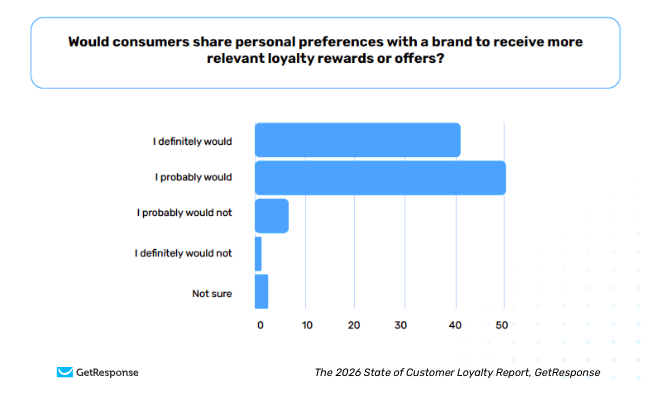
- 91% are willing to share preferences in exchange for better rewards
The appetite for loyalty is clearly there. But there is also a gap.
67% of consumers believe brands prioritize new customers over existing ones.
That perception, especially among frequent buyers, may be the defining loyalty signal of 2026.
This article breaks down the most important findings from the full State of Customer Loyalty 2026 report, highlighting where brands and customers agree, where they diverge, and what that means for ecommerce teams heading into the next year.
The 5 key customer loyalty findings of 2026
1. 67.3% of customers believe brands value new buyers more than loyal ones
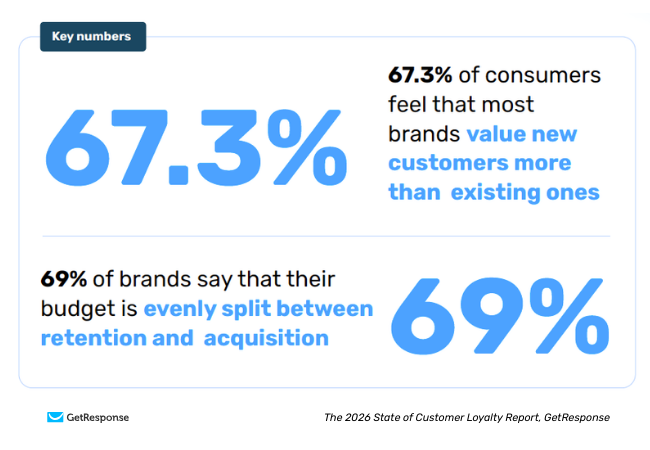
Even though nearly 7 in 10 brands report splitting their budget evenly between acquisition and retention, most customers don’t feel that balance.
Two-thirds of consumers agree that brands prioritize new customers over existing ones. That perception is strongest among frequent buyers – the customers who repurchase monthly and generate the most predictable revenue.
This disconnect suggests a communication and experience gap.
Retention may be a strategic priority internally, but the benefits are not consistently visible at the customer level. Early-access perks, recognition, status progress, or personalized rewards may exist — yet if they are subtle, delayed, or buried in promotional messaging, they fail to counteract the very visible incentives offered to new customers.
When new buyers receive clear discounts and welcome incentives, while loyal customers receive incremental or hard-to-earn rewards, the perception of imbalance becomes almost inevitable.
The issue isn’t whether brands invest in loyalty. It’s whether customers can see the results.
2. 64% of shoppers repurchase at least monthly — loyalty is already habit-driven
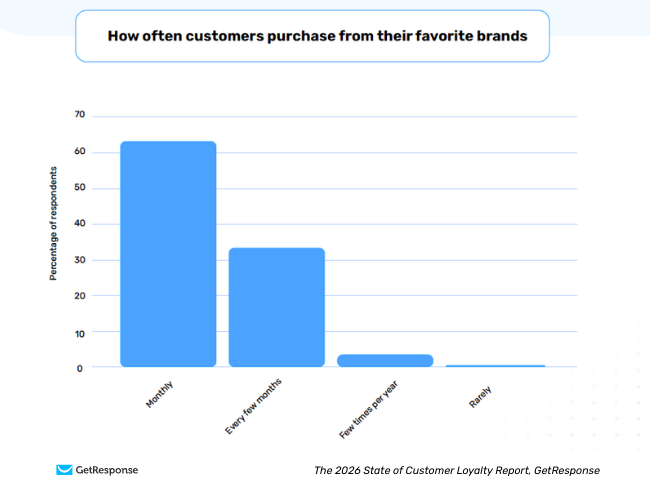
Customer loyalty in health, beauty, and wellness is not a rare outcome. It is routine behavior.
More than one-third purchase weekly, and nearly two-thirds repurchase from a favorite brand every month. In other words, most customers in these categories already operate on predictable replenishment cycles.
This frequency changes the conversation.
Brands often treat loyalty as something to build from scratch. In reality, repeat purchasing is already happening. The opportunity lies in reinforcing and stabilizing that behavior, not creating it.
When buying patterns are monthly, reminders, replenishment nudges, and recognition milestones can align naturally with customer routines. But when loyalty programs are disconnected from usage cycles, they risk becoming abstract point systems rather than practical tools that support existing habits.
High-frequency purchasing creates ideal conditions for retention strategies.
Loyalty programs work best when they follow customer behavior, not when they try to reshape it.
3. 91% of consumers are willing to share personal preferences for better rewards
One of the most common challenges brands cite in building loyalty is lack of customer data.
Yet on the customer side, resistance to sharing information is remarkably low.
More than 9 in 10 shoppers say they would definitely or probably share personal preferences, such as skin type or health goals, if it results in more relevant rewards or offers. Across age groups, the numbers remain consistently high.
This suggests the barrier is not privacy fatigue or unwillingness to engage. It is value clarity.
Customers are open to sharing information when the exchange is transparent and immediate. When preferences are collected but not reflected in future communication, the perceived value disappears. Over time, requests for data can start to feel extractive rather than helpful.
The opportunity is straightforward.
Preference data does not need to be complex to be effective. A small number of well-used signals can dramatically improve relevance, reduce generic promotions, and make loyalty feel personal rather than transactional.
Data willingness is not the constraint. Visible application is.
4. Customers prefer email for loyalty — brands rank social as most effective
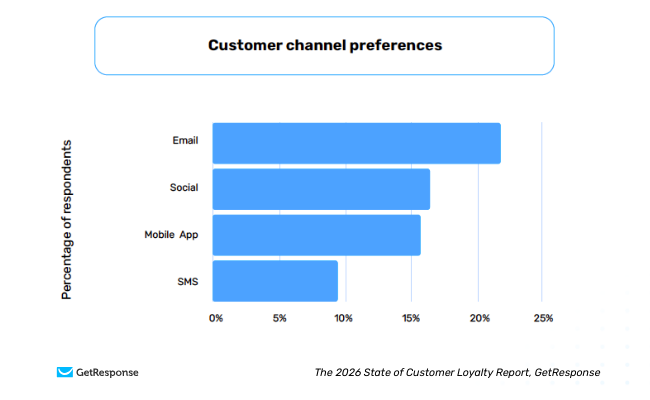
There is a subtle but meaningful channel gap between customers and brands.
When asked how they prefer to hear from their favorite health, beauty, and wellness brands, consumers rank email first. Social media and mobile app notifications follow, with SMS further behind.
Brands, however, tell a slightly different story. When asked which channels are most effective at driving loyalty and repeat purchases, social media ranks at the top, with email coming second.
The difference may seem small. Strategically, it is not.
Loyalty depends on visibility and consistency. If customers prefer to receive recognition, rewards, and updates through email but brands concentrate loyalty messaging elsewhere the program risks becoming fragmented or harder to notice.
This gap becomes more important as acquisition channels grow more volatile. Social platforms are powerful for discovery and engagement, but they are rented environments governed by algorithms.
Email marketing remains an owned channel, where brands control timing, frequency, and personalization more directly.
If loyalty messaging lives primarily in rented channels, its visibility will always be unstable.
5. 93% of consumers would join VIP or exclusive experiences — only 12% of brands offer them
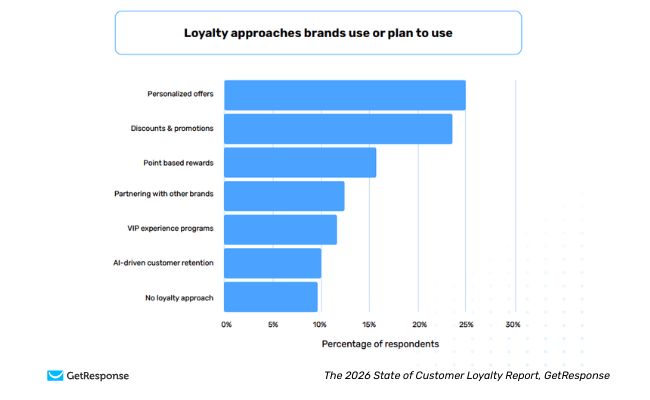
Customers show a strong appetite for recognition beyond discounts.
When asked whether they would participate in exclusive experiences or recognition programs offered by their favorite brands, more than 9 in 10 consumers say they would be very or somewhat likely to join.
The interest is broad and consistent across age groups and purchase frequency levels.
On the brand side, however, adoption remains limited. Only a small minority report running VIP or experiential loyalty initiatives. Most programs still center on discounts, points, or tiered rewards.
This creates a structural imbalance.
Customers indicate they value recognition, status, and exclusive access. Brands often respond with financial incentives. While discounts can drive short-term behavior, they do not always build long-term differentiation.
In categories where purchase frequency is already high, experiential elements — early access, member-only drops, priority support, or exclusive content — may create clearer signals of appreciation without relying solely on margin pressure.
Customer demand for recognition is already established. The next move is for brands to match it.
Taken together, these findings point to a consistent theme: customer loyalty in 2026 is not limited by customer interest. It is shaped by design choices.
Customers already buy frequently. They are open to sharing preferences. They are willing to engage in recognition-based programs. And they have clear channel preferences. The foundation for strong loyalty is present.
The gaps emerge in execution — in visibility, alignment, and experience.
When loyalty benefits are difficult to see, when programs are disconnected from purchase rhythm, when personalization is underutilized, or when communication happens in the wrong channel, retention strategies lose clarity.
The challenge moving forward is less about convincing customers to be loyal — and more about building systems that reflect how they already behave.
Where brands and customers diverge – and why it matters
Individually, each finding highlights a specific gap. Together, they reveal a broader pattern in how loyalty is experienced.
On the brand side, loyalty is clearly a priority. Budgets are allocated. Teams are assigned. Automation is in place. Retention is widely recognized as a long-term growth lever.
On the customer side, loyalty is also active. Buying frequency is high. Willingness to engage is strong. Openness to sharing preferences is widespread. Interest in recognition-based programs is clear.
Yet the experience does not always reflect that alignment.
Customers often perceive that new buyers receive more visible benefits. Brands believe they are investing in retention. Customers express clear channel preferences. Brands emphasize different ones. Customers show interest in recognition and exclusivity. Programs frequently center on discounts and points.
These differences are not dramatic in isolation. But together, they shape how loyalty is perceived.
- When acquisition incentives are louder than retention benefits, perception shifts.
- When programs are detached from predictable buying cycles, engagement weakens.
- When preference data is collected without visible personalization, relevance declines.
- When communication happens outside preferred channels, visibility suffers.
Over time, these small misalignments reduce clarity and impact.
Loyalty performs most effectively when program design, communication, and customer behavior move in the same direction.
What this means for loyalty strategy in 2026
The findings suggest that loyalty in 2026 will be less about launching new mechanics and more about refining alignment.
Most brands already have programs in place. The infrastructure exists. The next phase is about clarity — ensuring that what is built internally translates into something customers clearly experience.
Three shifts stand out.
First, visibility matters as much as investment. Retention budgets and automation flows are not inherently persuasive. Loyalty benefits need to be recognizable, immediate, and easy to understand. If acquisition incentives remain more visible than retention rewards, perception will continue to skew toward new customers.
Second, loyalty should follow behavior, not attempt to override it. In high-frequency categories, buying rhythms are already established. Programs that align with those rhythms — through replenishment timing, milestone recognition, and contextual communication — strengthen habits rather than compete with them.
Third, relevance must be demonstrable. Customers are open to sharing preferences, but they expect that information to shape their experience quickly. Personalization cannot remain theoretical. Even small signals, when applied consistently, reduce generic messaging and reinforce trust.
Finally, channel strategy becomes more important as acquisition grows more fragmented. Owned communication environments provide stability and control. When loyalty messaging is anchored in channels customers prefer and actively use, visibility improves without increasing noise.
Taken together, these shifts point toward a more disciplined approach to retention. The opportunity is not to make loyalty more complex, but to make it more coherent.
The data behind the study
These findings are drawn from the 2026 State of Customer Loyalty Report, based on responses from 2,400 consumers and 600 direct-to-consumer brands across six markets in the health, beauty, and wellness sectors.
Together, they represent 3,000 perspectives on how loyalty is perceived, built, measured, and experienced today.
The full report explores:
- How retention priorities differ by company size
- Where Gen Z and Millennials behave differently
- Which loyalty approaches brands are investing in
- The biggest sources of friction inside existing programs
- And how brands are measuring retention performance in practice
Customer loyalty is no longer a peripheral marketing tactic. It is becoming a structural part of how ecommerce brands manage growth in an environment where acquisition costs fluctuate and platform control shifts.
Understanding where customers and brands align — and where they diverge — is the first step toward building loyalty systems that are durable, visible, and measurable.
The complete 2026 Customer Loyalty Report provides the full dataset, detailed breakdowns, and strategic analysis behind the findings summarized here.
