
74% of consumers want to receive brand messages, offers, and product updates via email. 42% say they prefer to see those communications via text messages.
The same Epsilon report explains that while 66% of consumers receive at least one relevant email from a brand daily, only 19% find the text or SMS messages they receive relevant.
One reason for that gap is that marketers approach SMS and email as two distinct marketing channels. They don’t coordinate the two, and that results in issues like irrelevant and excessive communication.
In this article, I will show you how to orchestrate the customer journey to deliver a personalized omnichannel experience where email and SMS tell one continuous story. You will see how different brands are already doing this and the exact workflows they use.
Key takeaways
- Combine email and SMS using a multichannel marketing platform to deliver a consistent customer experience where your messages complement each other.
- Email is perfect for long-form content that requires advanced formatting, while SMS is great for shorter communications where immediacy is the priority.
- Email and SMS marketing are subject to different regulations depending on your location. These include GDPR and applicable EU electronic marketing rules, CAN-SPAM for commercial emails in the US, and TCPA for certain marketing text messages and calls. Make sure you have the appropriate consent or other legal basis before sending promotional communications. Include an unsubscribe link in your emails and an opt-out option in texts.
- GetResponse offers an omnichannel lifecycle marketing platform that lets you orchestrate seamless customer journeys across email, SMS, and push notifications. It tracks customer behavior on your website and their engagement with your campaigns to send relevant email and SMS campaigns.
Why you should combine SMS and email marketing
Combining SMS and email marketing elevates the customer experience. It eliminates issues like excessive messaging, irrelevant communications, and duplicate messaging.
Orchestrating the customer journey helps you manage communications across email and SMS from a single dashboard. You can decide at what touchpoints to use email vs. text messages. You control when each message goes out and the exact content of every communication.
All that is possible through omnichannel marketing automation solutions like GetResponse.
The platform lets you build automated workflows that combine email and SMS campaigns. You can send long communications via email and follow up with shorter text messages. Or, use text exclusively for contacts who prefer that channel.
And it doesn’t always have to be expressed preferences.
Lifecycle automation tools track how customers engage with your communications across email and SMS. They use engagement signals to determine each contact’s preferred channel. Future messages are then automatically sent through that channel.
Better customer experiences also drive business results.
Orchestrating the buyer journey means you deliver the right messages based on real-time customer behavior. This increases engagement rates since customers see relevant messages at the times they’re most likely to act.
Combining the two channels also means you get to play into their distinct strengths. As email helps you with long-form communications, SMS supports urgent messages like flash sales, time-limited offers, and critical follow-ups. This increases your marketing ROI tremendously.
According to McKinsey, better customer experience increases sales conversion by 10-15% and boosts customer satisfaction by 10-20%.
When to use SMS vs email marketing
SMS is perfect for short, time-sensitive communication, while email is ideal for longer communications where you want more formatting options.
According to TechJury, 90% of text messages are opened within the first 3 minutes. SMS messages also enjoy a 98% open rate.
In contrast, the latest email marketing benchmarks report an average open rate of 39.64%.
But the best part about email is that you get rich formatting options. You can add media like images and videos. It also supports long-form content, so you can use storytelling to hook subscribers and build a strong emotional connection.
Here are the specific campaigns where SMS thrives:
- Flash sales
- Transactional messages like order delivery alerts
- Time-sensitive reminders
- Product feedback
- Back-in-stock alerts
Email excels at these campaigns:
- Educational content
- Sales and discounts
- Brand and product announcements
- New product launches
- Transactional updates like order confirmation receipts
- Onboarding sequences
SMS and email marketing compliance
GDPR and CAN-SPAM have strict rules for brand email and SMS communications. Build a compliant SMS marketing strategy from the ground up by collecting explicit user consent, as required by TCPA regulations. Violations attract fines of between $500 and $1,500 per violation.
Consent for promotional emails is also crucial if your business operates in the EU.
You also want to make it easy for subscribers to opt out of both lists. So add an unsubscribe link for email and provide a STOP option for SMS marketing campaigns.
CAN-SPAM requires that all email opt-out requests are fulfilled within 10 business days.
GetResponse simplifies CAN-SPAM and GDPR compliance through built-in compliant management tools. Our solution lets you add consent fields to sign-up forms, webinars, and landing pages. This allows users to explicitly tell you what messages they want to receive from you.
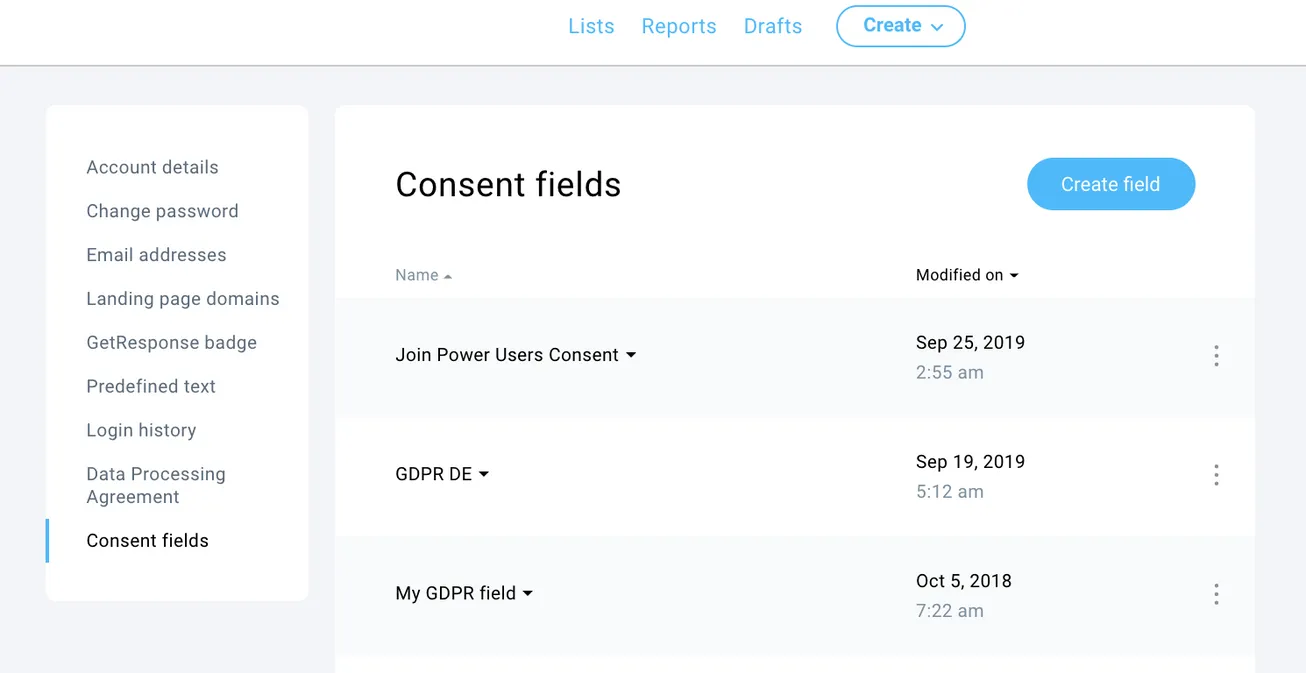
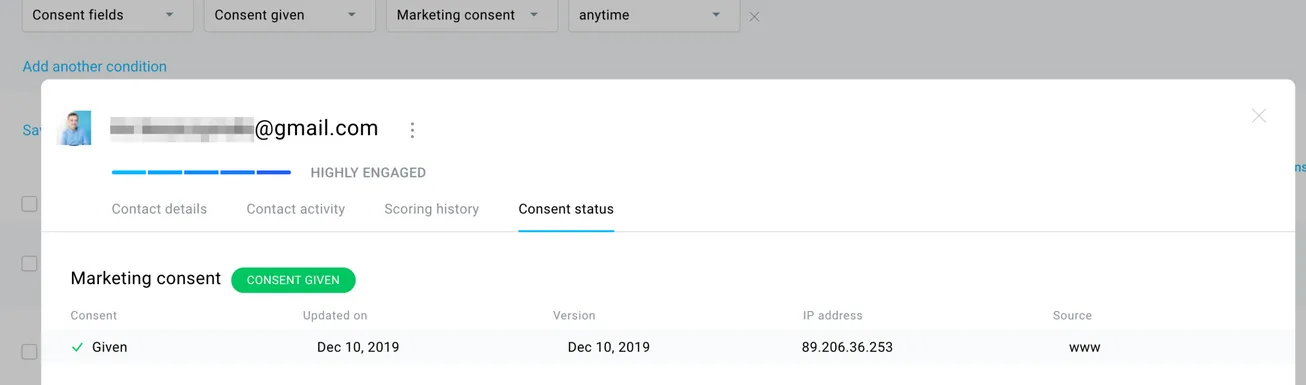
We provide tools that let you update contact details per subscriber requests, maintain consent records, and delete customer data.
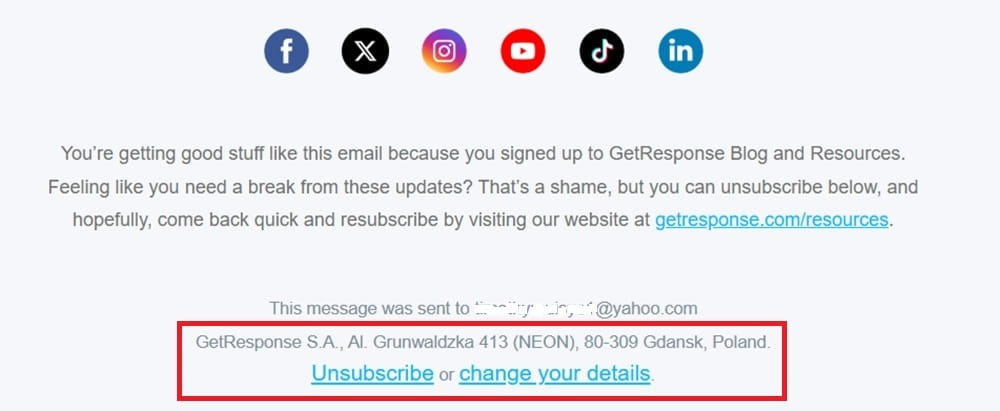
Subscribers can change or update their information through a self-service contact update link. All email marketing campaigns include an unsubscribe link and business address in the footer, which is vital for CAN-SPAM compliance.
These tools make it easier to manage consent and comply with applicable marketing regulations. However, you are still responsible for ensuring that your forms, campaigns, and data processing practices meet the legal requirements in your markets.
How to combine email and SMS marketing across 9 campaigns
Here’s how to combine email and text messages in the customer journey:
1. Welcome series – The Spice House
A welcome email and SMS campaign makes sense if a customer has signed up to both your email and SMS lists.
Email is the perfect channel to tell the customer more about your business. Tell the story behind your brand and introduce the shopper to the different product categories in your store. Start with the best sellers.
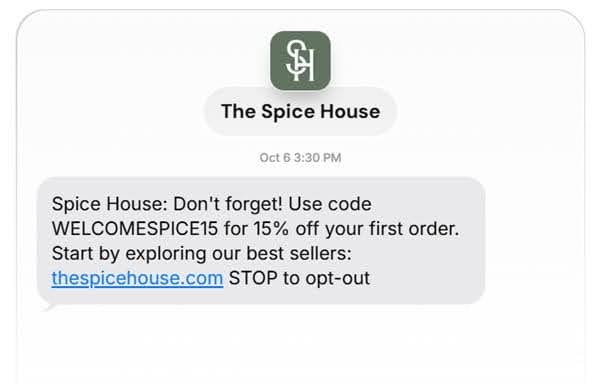
The Spice House offers a 10% discount if you join their email list and an additional 5% (for 15% total) if you also sign up for text messages.
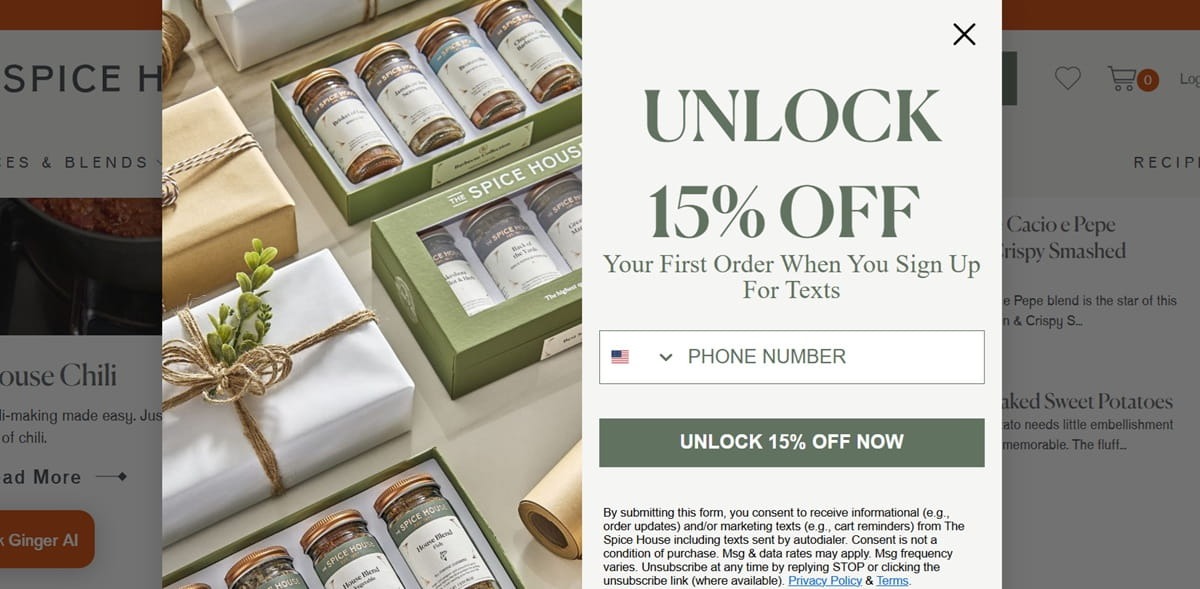
The welcome email gives you the 10% discount and introduces you to the store’s best sellers. That email also includes social proof and a store locator map.
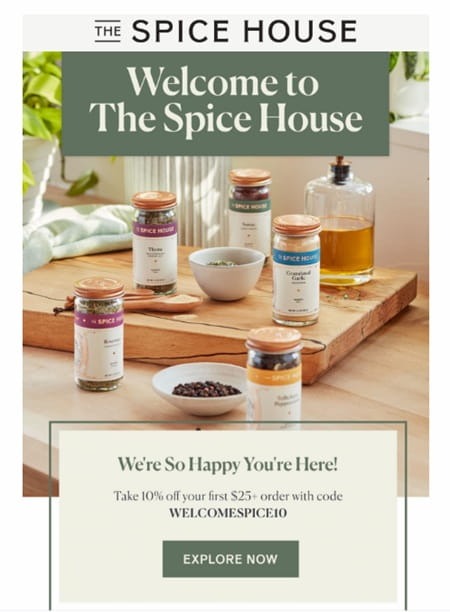
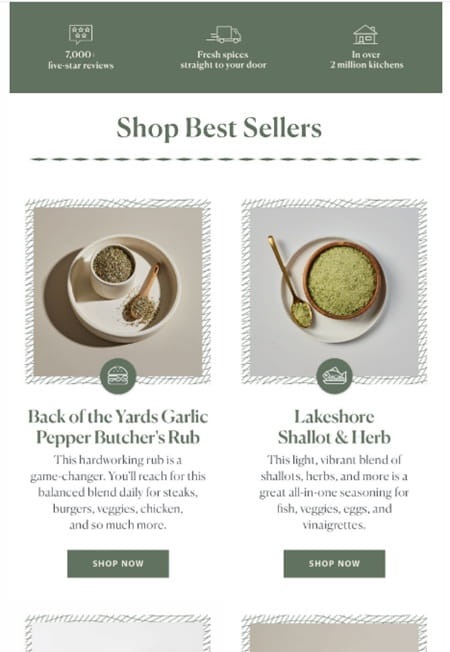
Customers who join the SMS list receive a text message in addition to the welcome email. The text offers the 15% discount and links to the store’s best sellers.
This GetResponse automation workflow lets you build a CAN-SPAM and GDPR-compliant welcome series combining both email and SMS messages.
2. Abandoned cart reminders – Track Spikes
Most marketers use email for abandoned cart recovery campaigns and ignore SMS entirely.
Combining the two channels in an abandoned cart recovery sequence is more effective, especially if you coordinate them correctly.
Start with the standard abandoned cart recovery email. Follow that email with a shorter abandoned cart recovery text message. But here’s the catch.
Don’t send the text message to everyone. Track shoppers who open your first email and complete their orders. Exclude them from the follow-up text message.
For shoppers who haven’t opened or completed their order, send a follow-up text message with an incentive like a discount.
For example, this ecommerce brand offers a 10% discount, valid for the next 24 hours. That puts pressure on the buyer to complete their purchase while the offer is still available.
The text message also links directly to the buyer’s shopping cart to reduce friction.
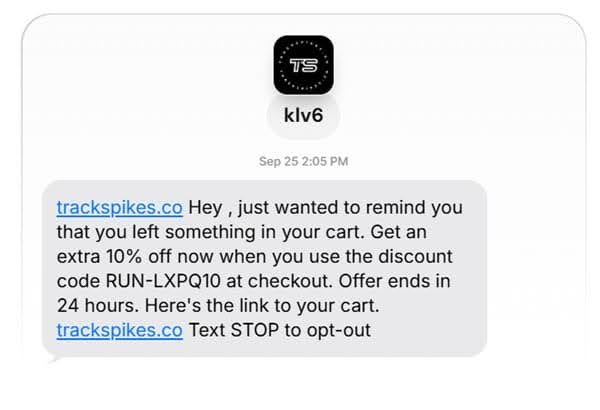
The best ecommerce automation software tracks contact engagement with your campaigns. These platforms can detect customers who open your abandoned cart email and go on to complete their orders. They exclude those contacts from follow-up text message marketing campaigns.
Here’s the automation workflow for this multichannel abandoned cart recovery campaign.
3. Black Friday Cyber Monday campaign – Casper Sleep
BFCM is the biggest revenue event for most online stores, and it’s perfect for both email and SMS campaigns.
Strategic brands start BFCM campaigns weeks in advance with early-access campaigns. That’s where email thrives.
Build anticipation for the Black Friday sales event by sending a series of emails in the weeks leading up to the event. Start with a “Save the date” email informing customers when your Black Friday sale will go live.
Apple sent this pre-launch email to its customers in the days leading up to Black Friday and Cyber Monday.
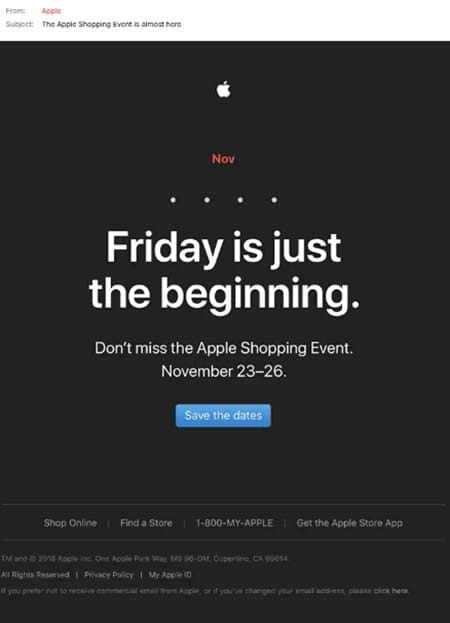
What’s interesting about this email is that the CTA allowed subscribers to add the event to their calendars. This is brilliant because it meant that customers would receive calendar notifications from Black Friday through Cyber Monday.
Apple won’t be competing in the inbox with the tens of other brands sending Black Friday emails on that day.
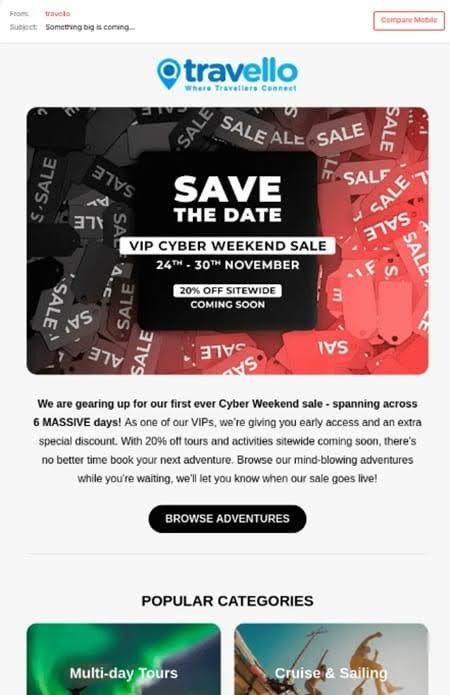
Then there’s the early-access email. This is really important, particularly to your VIP customers. It makes them feel valued, which strengthens their loyalty.
Travello sent the following early-access email that allowed their loyal customers to book adventures days before the Black Friday sale went live.
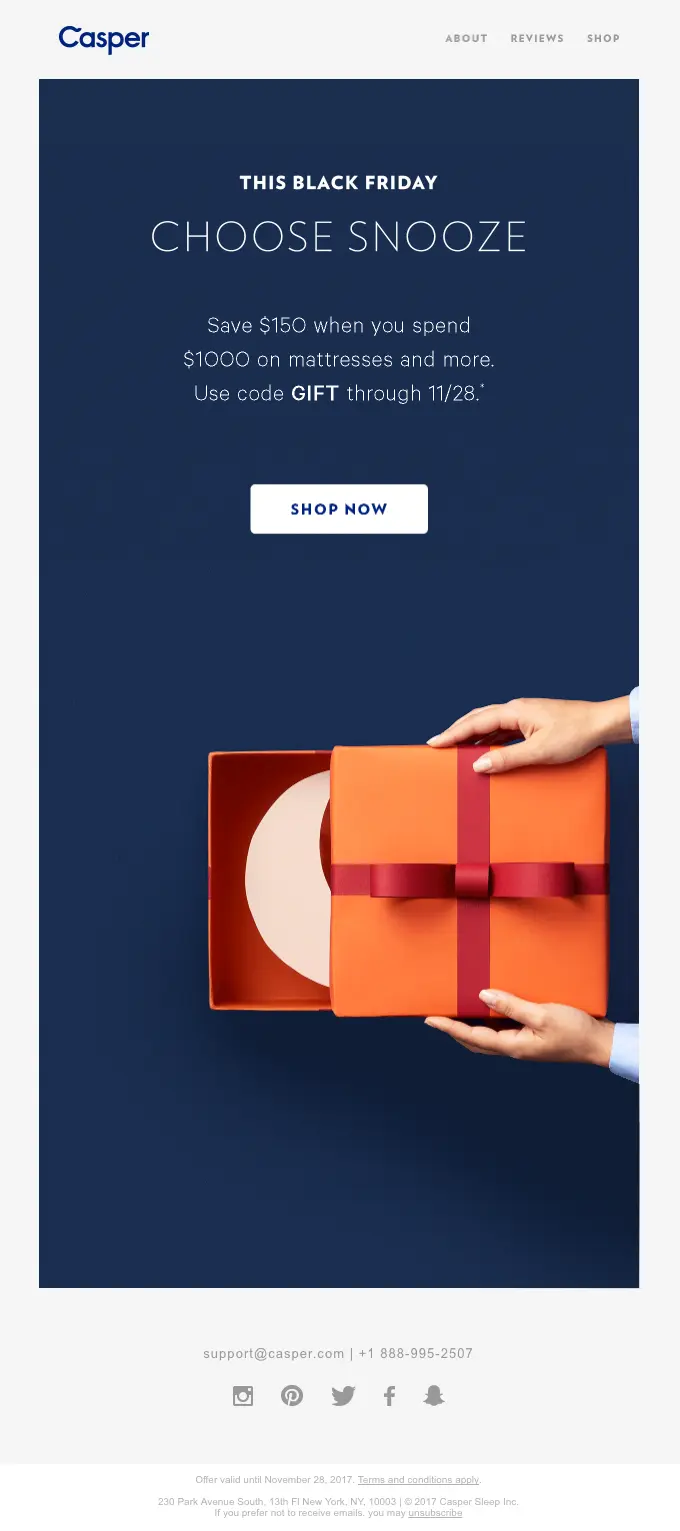
You can also send an email on Black Friday telling customers that the sale is now live, like Casper did with the email below.
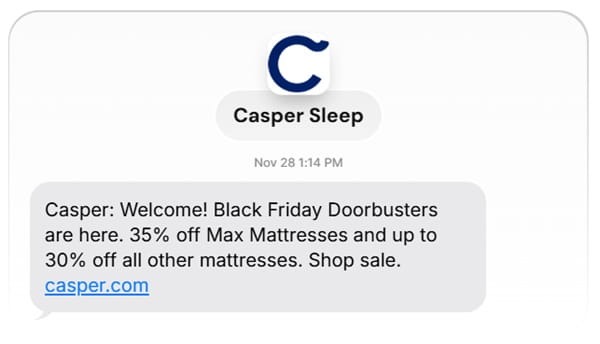
Text messages come in on the day of and hours before the BFCM sale event ends.
Use it on the day of to alert the warm customers you’ve already engaged with via email that the sale is finally live. That’s what Casper did with this text message.
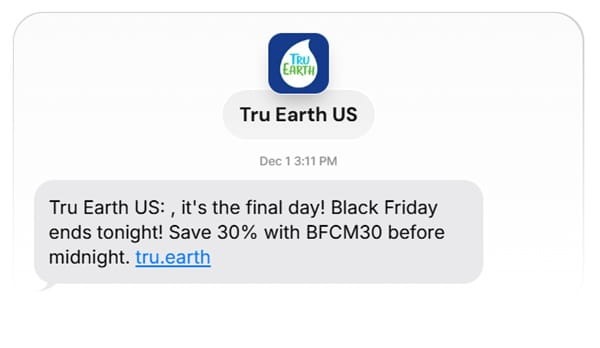
Send another batch of messages a few hours before the sale ends. Like this text from Tru Earth US.
Some brands send additional emails and text messages after the BFCM event. The goal is to tell your subscribers that some discounts are still available.
These campaigns are effective when you want to target procrastinators or shoppers who might have missed your emails due to a crowded inbox filled with BFCM emails. They also help you capture buyers who might have been waiting for payday.
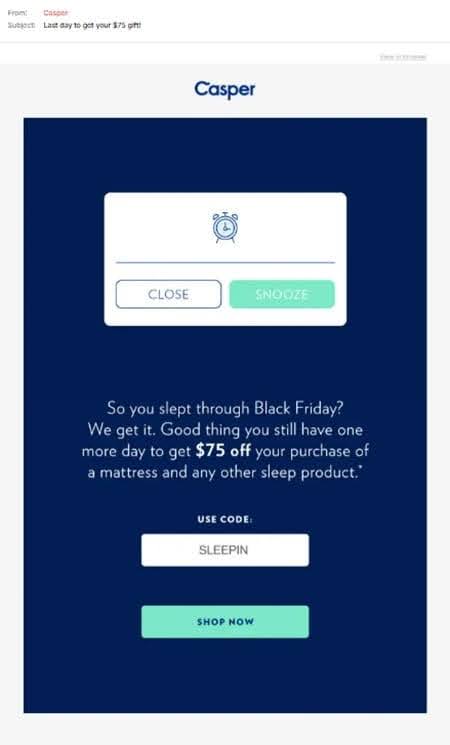
Here is the email Casper sent after Black Friday.
GetResponse’s segmentation tool lets you create strategic BFCM segments like VIP customers vs. engaged subscribers who haven’t bought anything from your store vs. lapsed customers who haven’t engaged with or bought from your store in a while.
Target each group with strategic BFCM campaigns like early-access emails for VIPs, bigger discounts for engaged contacts, and winback Black Friday discounts for lapsed customers.
4. Back-in-stock campaign – Lane Frost Brand
Back-in-stock is a crucial behavior-based campaign.
Some stores let customers choose whether they should be alerted when the item they were looking at is restocked.
The problem with that approach is that not every customer will go for the option. Some shoppers will simply leave your ecommerce site once they realize the item they wanted is out of stock.
Using a behavioral trigger (in addition to expressed interest) allows you to target all the customers who browsed through the items that were out of stock. Of course, you will only target customers who have shared their contact information and consented to your communications.
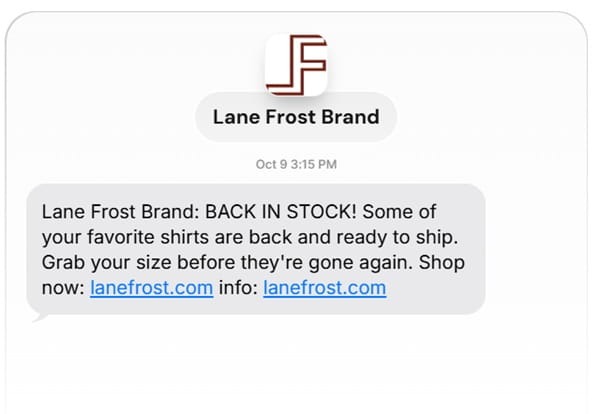
Email is ideal as the first point of contact to announce the restocked items. Follow it up with a short text message like this one from the Lane Frost Brand.
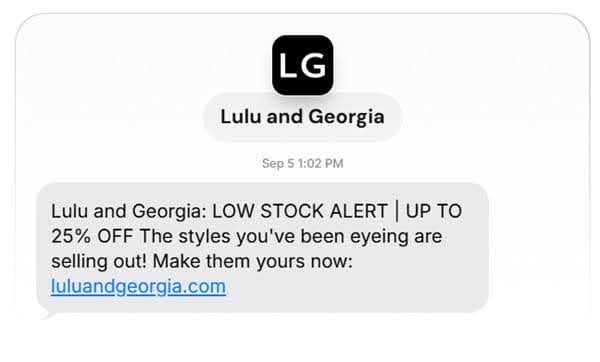
Lulu and Georgia run another clever version of this campaign where they alert customers when the items they’ve been browsing are running low in stock.
Both back-in-stock and low-stock alert campaigns require tracking customer behavior on your site so you can see the items they interact with.
The GetResponse automation software integrates with all major ecommerce platforms, including WooCommerce, Shopify, Magento, and PrestaShop. It allows the automation platform to track customer behavior on your site.
You can use customer browsing and purchase behavior to create targeted marketing automation workflows. For back-in-stock campaigns, you’ll also need access to updated product inventory data to identify when previously unavailable items become available.
Instead of blasting a back-in-stock email and SMS to everyone on your list, you send them to individual customers who’ve already shown interest in the items. This is more targeted and likely to generate a higher ROI.
5. Replenishment reminder – Chewy
Replenishment campaigns are a must for any brand selling products that require regular restocking.
Beauty and pet supply businesses are the perfect example here.
Start with a simple email workflow about a week before the product runs out. Follow up with an SMS reminder 1-2 days before the items run out if the customer still hasn’t made the purchase.
While the workflow itself is simple, it’s important that you time the messages correctly. Your customer shouldn’t receive the reminder too early or too late.
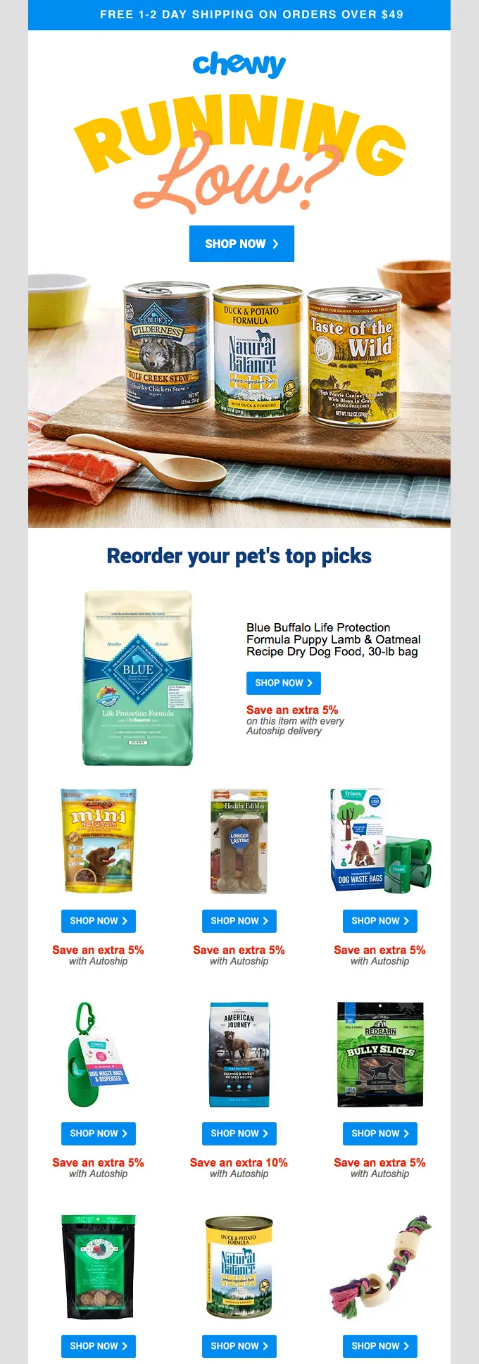
Also, make the reordering process effortless. Add a link to a pre-filled shopping cart containing the products the customer usually buys.
Chewy does exactly that with this replenishment reminder email.
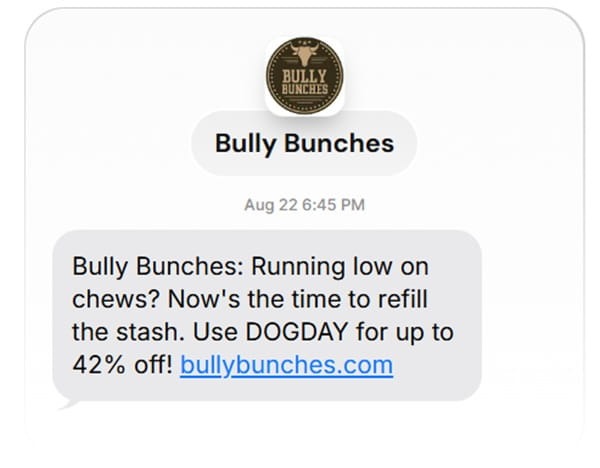
Bully Bunches, which is also in the pet food industry, sends the following replenishment reminder text message.
Customize our prebuilt replenishment reminder workflow to add a follow-up SMS that targets customers who don’t convert after the initial email.
6. Flash sale campaign – Lane201
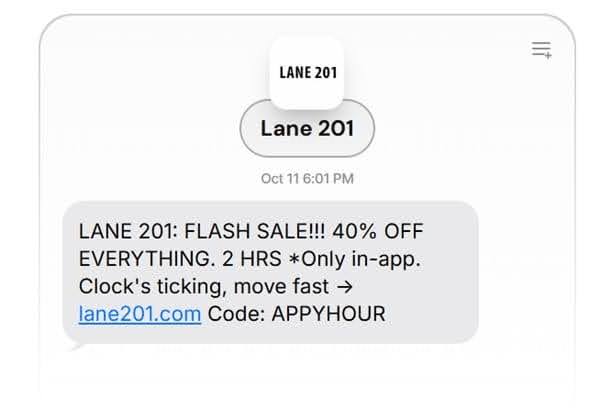
Flash sales last for only a few hours, so you must pass the message to customers quickly. That makes them perfect for SMS messages.
But that doesn’t mean email has no place in flash sale campaigns.
To increase your chances of success, use email to build the hype for your flash sale event. Send one or two emails several days before the final flash sale SMS.
For example, the first email could go out on a Monday. This email would tell customers that a big sale is coming soon. It could also highlight the product categories that will be on sale and provide a hint at how much buyers would save.
The second email goes out on Wednesday. This email tells customers the specific time the sale will go live and the exact discounts customers should expect. It also reminds customers to keep an eye on their SMS inbox for the announcement.
The email needs to create some FOMO, too. Point out that there will be a limited number of items per category.
Then the final time-sensitive message goes out on Thursday via SMS. The time between the last email and the flash sale SMS must be short to keep the offer fresh in customers’ minds.
The SMS message should be brief and communicate urgency. Lane201 does a great job with this text.
7. Winback campaigns – ILIA Beauty
Use winback campaigns to bring back lapsed customers and maintain contact list hygiene.
A multichannel winback campaign is your best shot at re-engaging customers who’ve gone quiet on one channel. While they may not open your emails, an SMS allows you to confirm if they’re still interested in your brand or not.
If they don’t respond after several re-engagement emails and SMS follow-ups, remove them from your lists. This prevents them from reporting you as spam, which would impact your sender reputation and deliverability.
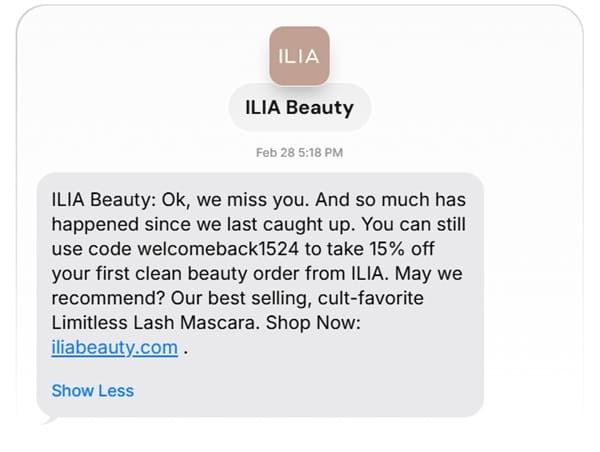
Ilia Beauty sends the following re-engagement SMS message to lapsed customers. Notice how they’ve included an offer and a curated list of their best sellers in the text. This can reignite the customer’s interest in the brand.
Here is a three-part winback workflow.
The first email campaign reminds the customer about the brand and what has changed or its latest offerings. The second part is an SMS campaign, where you can add a discount.
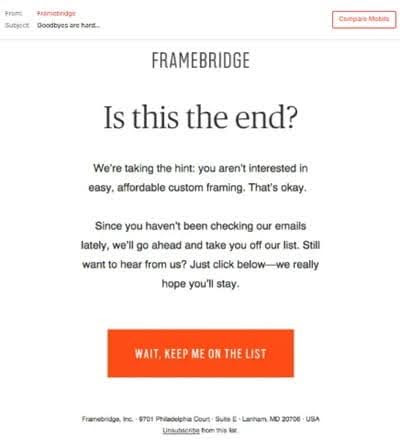
The final part should be a goodbye email telling the customer you are removing them from your list unless they choose to stay. Something similar to this.
8. Delivery alert campaigns – Usual Wines
Delivery alerts are a transactional email campaign that has a direct impact on customer experience.
After placing an order, customers expect an order summary and receipt, shipping notifications, and delivery alerts. Proactive communication means customers don’t flood your customer support team asking for updates.
Use email to send the order confirmation email. That email should provide the order summary, a sales receipt, and a delivery ETA.
Send a follow-up email with shipping information once the items have been handed over to the courier. The tracking link is usually included in this email.
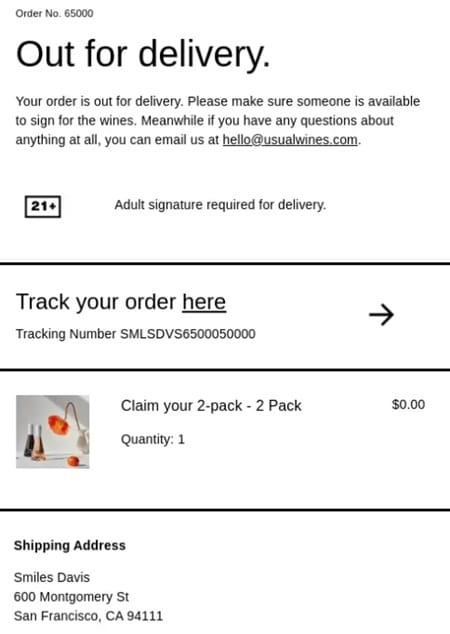
Use text messages when the items are out for delivery to give the customer real-time updates.
As the courier sends delivery updates to your store via an API, your store shares the same updates with the customer via text.
Update the customer when the items are out for delivery, once they’re delivered, or if they’re delayed.
You need a reliable transactional email service for these campaigns. One that guarantees high deliverability to ensure messages reach your customers.
Read our review of the top transactional email service solutions to find a good option for your brand.
9. Feedback collection – Hint Water
Both email and SMS can help you collect customer feedback. While you can combine the two channels for this purpose, with SMS being the follow-up medium, it’s also possible to get good results using them independently.
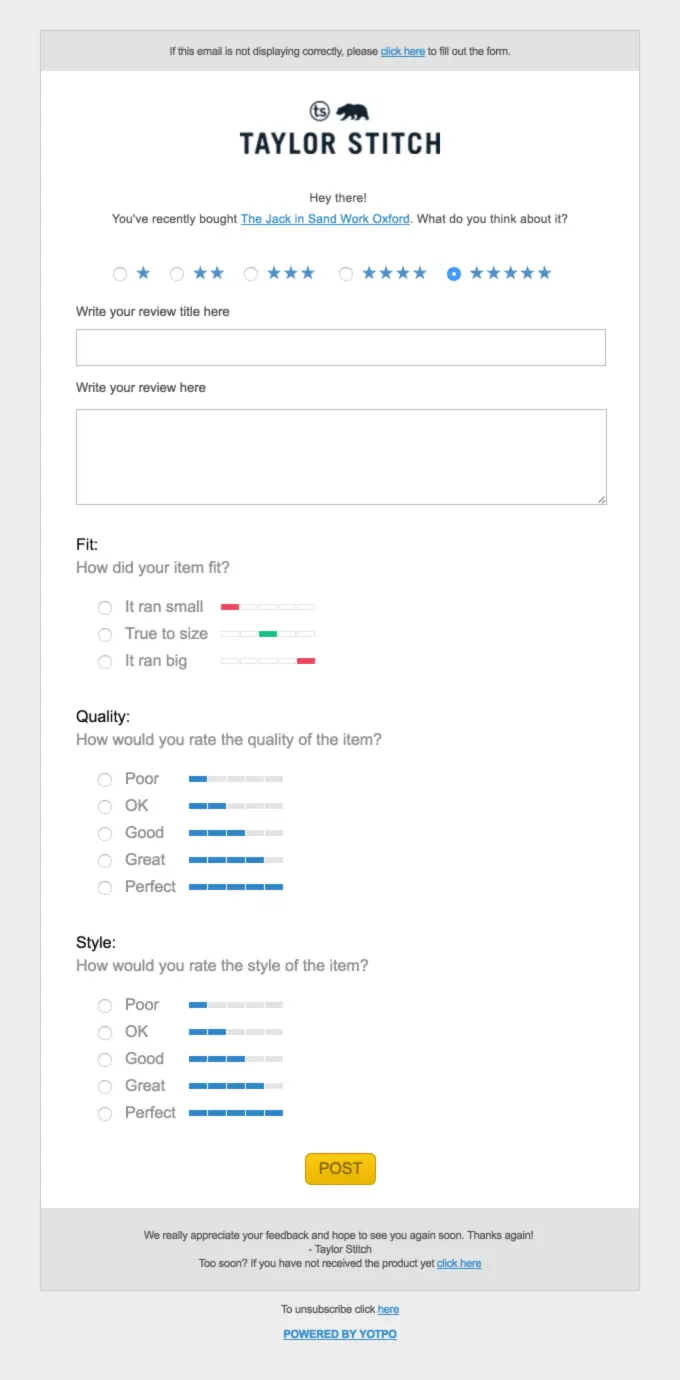
Email can help with post-purchase feedback collection, for example.
It also helps with general feedback collection.
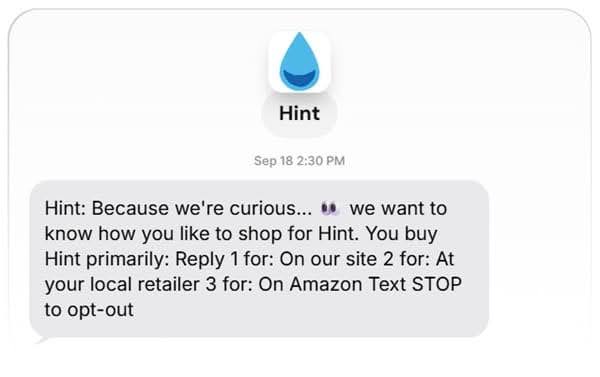
SMS can be valuable for quick feedback. For example, it’s great for conducting a short survey on customer satisfaction after a customer service interaction. You can also send SMS messages to collect feedback that helps you understand your customers better.
Check out this feedback collection SMS message from the beverage brand Hint, for example.
Besides short, quick feedback, SMS also lets you collect general feedback. Simply add a link to your survey in the text, like Glo Skin Beauty did below.
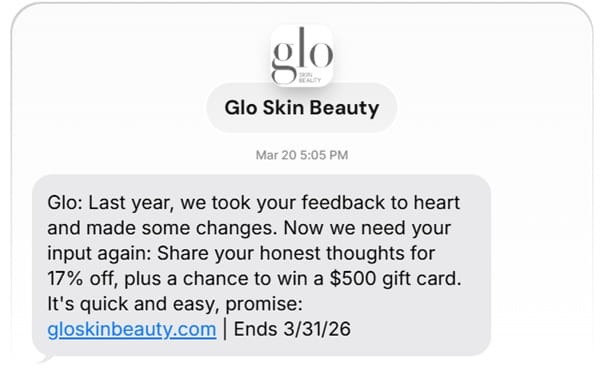
The workflow below combines email and SMS messages for feedback collection. And it only sends text messages to contacts who do not respond to the email survey.
Using GetResponse for SMS and email marketing
Email and SMS are valuable owned channels every business should invest in. But don’t fall into the trap of running separate strategies for each.
Integrating SMS and email allows you to take advantage of each channel’s strengths to deliver a personalized omnichannel experience.
GetResponse is a lifecycle marketing platform that helps you engage customers through email marketing and automated workflows. Its Enterprise plan also supports SMS marketing and mobile push notifications, allowing you to coordinate customer communications across multiple channels. It connects to your online store, allowing you to orchestrate customer journeys through behavior-triggered workflows.
So you can combine different channels to send relevant messages that align with individual customer actions and preferences, as well as their stage in the buyer journey.
Check out this short customer story of how Med & Beauty used GetResponse’s email and SMS marketing tools to generate $43,000 in revenue in 5 months with an 873% ROI.
SMS and email marketing campaigns FAQs
1. What is the best email and SMS marketing platform?
The best email and SMS marketing platform depends on your automation needs and budget. GetResponse lets you build coordinated email and SMS campaigns that comply with GDPR, CAN-SPAM, and TCPA regulations. It lets you build complex multichannel workflows so you can send personalized email and text messages based on real-time customer actions. Plus, it supports other marketing channels, including push notifications.
2. Is SMS marketing legal in the US?
Yes, SMS marketing is legal in the US, but businesses must comply with applicable federal and state laws, including the TCPA. Marketers generally need appropriate consent before sending promotional text messages and must provide a straightforward way for recipients to opt out. Collect explicit consent from customers before sending SMS marketing messages and provide a straightforward way of opting out.
3. How much does it cost to do SMS marketing?
SMS marketing starts from as low as $0.01 per text. The exact cost ultimately depends on the SMS marketing software you choose and the country your recipients reside in.
4. Is email marketing still worth it in 2026?
Yes, email marketing is still crucial in 2026, especially for customer retention. As customer acquisition costs increase, email is helping brands nurture customer relationships, build loyalty, and drive repeat purchases without relying on expensive paid acquisition channels.
