
Ecommerce personalization is customizing the online shopping experience for individual customers. Instead of showing shoppers the same generic messages and products, you tailor marketing messages, product recommendations, and offers to align with their unique preferences.
Ecommerce personalization tools track customer preferences, purchase history, and shopping habits. That data is then used to tailor the online shopping experience.
Personalization is crucial for modern ecommerce, with 80% of customers reporting that they expect personalized brand experiences. These customers spend 50% more with such brands. But while 92% of retailers think they provide personalized experiences, only 48% of consumers agree.
This article analyzes four ecommerce personalization software tools that help you close that gap. We examined tools that let you personalize critical aspects of the online shopping experience, from product discovery and recommendations to marketing campaigns.
Key takeaways
- Ecommerce personalization involves tailoring the customer experience so each customer sees products and content that align with their interests.
- Ecommerce personalization tools use customer data and behavior like purchase history, browsing behavior, and campaign engagement levels to personalize shopping experiences.
- The best personalization tools depend on the specific customer touchpoint you want to personalize. Bloomreach, for example, is ideal for product discovery personalization. GetResponse is great for ecommerce email and SMS marketing personalization.
- GetResponse is a lifecycle marketing platform that lets you personalize omnichannel campaigns. The marketing automation software provides dynamic content boxes and AI-powered product recommendations that deliver relevant content and product suggestions to each customer.
Top ecommerce personalization software comparison
| Tool | Best for | Key features | Pricing |
|---|---|---|---|
| Bloomreach | Search and product discovery personalization | – Loomi AI search that understands natural language and terms not in product descriptions – Conversational shopping assistant that answers follow-up questions – AI studio to customize algorithm weighting – Image search | Not publicly shared. Most brands spend $60,000/year, according to Bloomreach. |
| GetResponse | Email and SMS personalization | Automated email, SMS, and push campaigns triggered by behavior – Dynamic content boxes for personalized content – Self-learning AI product recommendations – Contact scoring and tags for segmentation – Revenue attribution | Marketer plan starts at $48.38/mo. |
| Nosto | Ecommerce search and merchandising | – Personalized search with auto-suggestions – Category merchandising personalized by segment or individual shopper – Dynamic product bundles – UGC management | Pricing not publicly available. Depends on traffic, gross merchandise value (GMV), modules, and support. |
| Insider One | Customer data management and activation | – Customer data platform (CDP) – Cross-channel journey orchestration – Self-improving AI that adapts journeys, assists shoppers, and handles support – Reporting and analytics | Capterra reports pricing starts at £1,000 (roughly $1,300) per month |
Best ecommerce personalization tools
Here is an in-depth review of the top ecommerce personalization software solutions and their best use cases:
1. Bloomreach – Best for search and product discovery personalization
Bloomreach offers an ecommerce search and product discovery system. The platform is powered by Loomi AI, which supports smart browsing, conversational shopping, and AI-powered product recommendations.
Loomi AI understands the natural language customers use to search for products. Whether that’s a single keyword or longer searches. It even understands words and phrases that are not included within your product descriptions. This allows the AI to return relevant results every time.
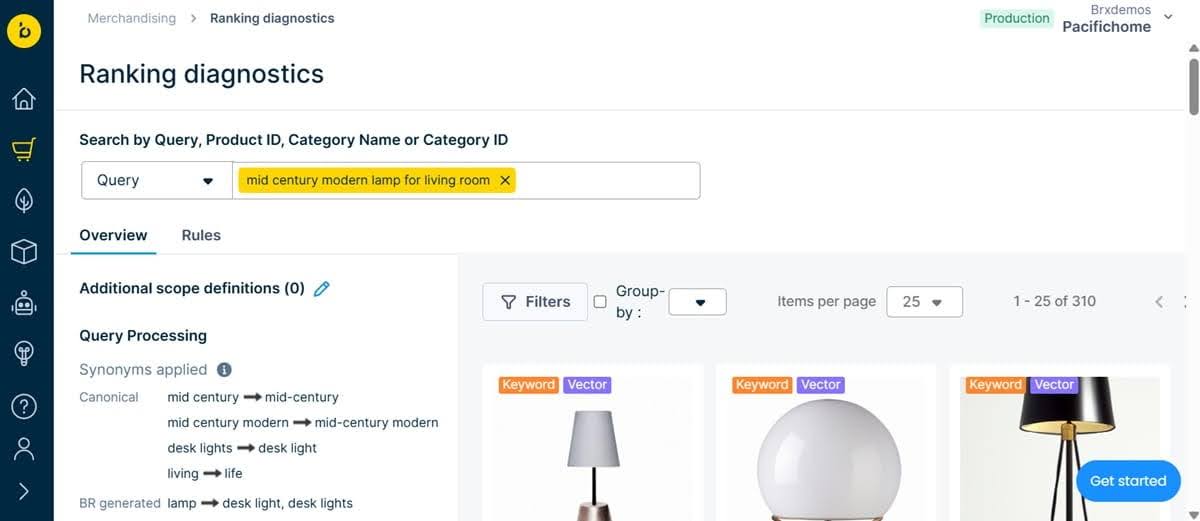
The platform turns your search bar into a conversational assistant. This lets shoppers interact with an AI shopping assistant, where they can ask follow-up questions regarding sizes or your return policy.
Customers can even do an image search by uploading product photos. This is particularly ideal for enterprise ecommerce stores that have vast product catalogs.
Bloomreach offers an AI studio, which is ideal for ecommerce business owners who want more control over the product discovery and search algorithms. The studio lets you customize how the algorithm works.
For example, it lets you decide how much weight each data signal should carry. You could configure it such that “add to cart” carries more weight than “product clicks.” That influences how products rank when customers search. So items that get more adds to the cart outrank the ones getting more clicks.
This is essential, as it allows you to customize the algorithm based on how your business works and the unique attributes of your customer base.
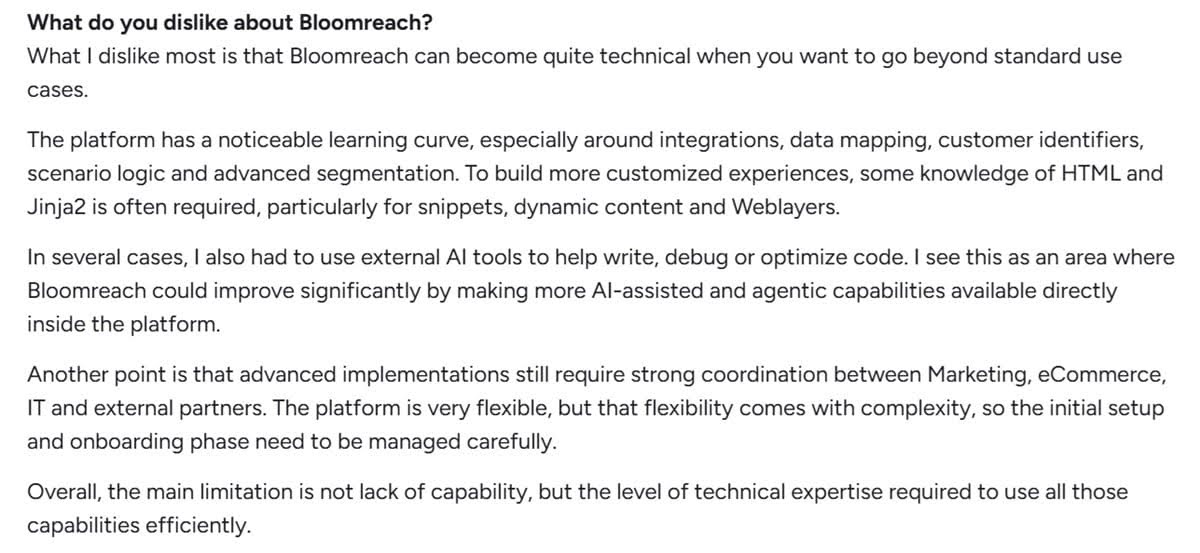
As for limitations, multiple users have complained about Bloomreach’s complexity. The platform does require technical expertise, especially when you move beyond the standard use cases. Pietro explains it really well in this G2 review.
Other features
- Dynamic product grids – Loomi AI lets you personalize product pages based on real-time behavioral signals and customer segment activity. It also allows you to adjust the position of products within grids based on real-time data.
- A/B testing – Run A/B tests to see how algorithm and merchandising changes influence the average order value and conversion rates.
- Personalized recommendations – Use product performance and customer profile data to recommend relevant products most likely to convert shoppers. You can customize the recommendation engine to show high-margin products, favor certain brands, or display top-rated products.
- Marketing automation – Beyond ecommerce search, Bloomreach also provides a marketing automation tool for email, SMS, and WhatsApp marketing campaigns.
Pricing
Bloomreach does not publicly share pricing information. There’s also no free trial.
Pricing usually includes a fixed platform fee and a usage fee that varies depending on the tools you use. The tools are split into three categories, according to their G2 profile:
- Autonomous marketing – This offers AI marketing tools, like SMS and email marketing.
- Autonomous search – This provides AI site search, personalized product recommendations, and insights for merchandisers.
- Conversational shopping – This enables the AI shopping agent.
You can also buy just a single solution, like the autonomous marketing module. Then, invest in search and conversational shopping tools as your store grows.
That said, Bloomreach does point out that most brands spend $60,000 per year on the platform. That’s steep, but it makes sense for enterprise stores with vast product catalogs and high website traffic.
2. GetResponse – Best for email and SMS personalization
GetResponse is a customer retention and lifecycle marketing platform. It connects to your ecommerce store and lets you automate every step of the customer journey.
The integration with your online store allows GetResponse to track shopper behavior like the pages they view and products they click. It also tracks order history and how customers engage with your campaigns.
This lets you run personalized omnichannel campaigns that align with individual customers’ preferences and shopping habits. You can send personalized email, SMS, and push notification campaigns in response to specific customer actions.
For example, use cart abandonment as a trigger to activate an abandoned cart recovery workflow. Or dropped engagement levels to trigger a customer winback campaign.
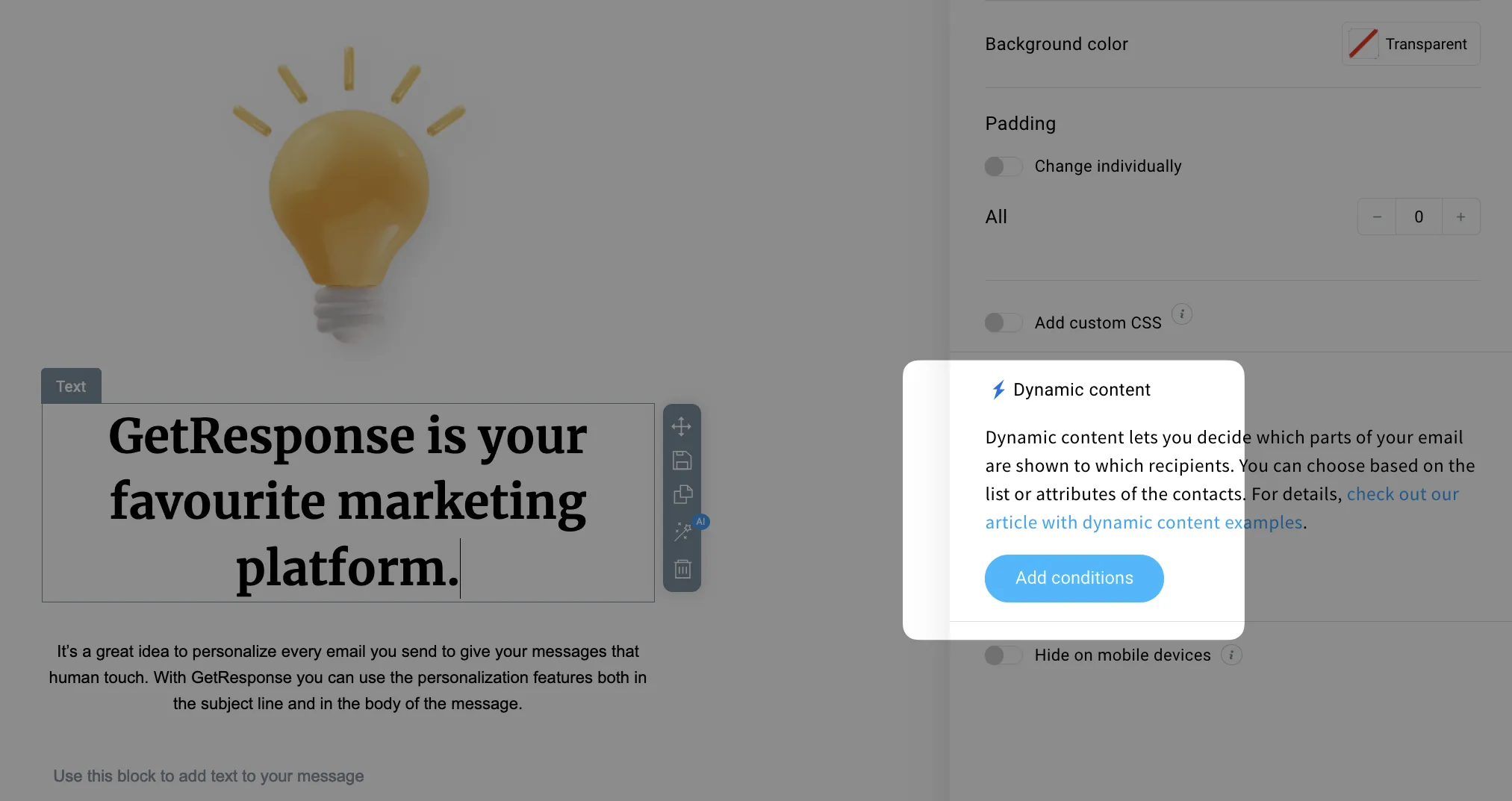
Our solution also supports dynamic content boxes. This allows you to personalize email content based on specific user attributes.
GetResponse offers an AI product recommendation engine for ecommerce stores. The self-learning AI uses real-time customer behavior like browsing history and patterns to show site visitors products they are most likely to buy.
It recommends products based on a shopper’s previous visit to your store, for example. It can also pull and recommend best sellers in your store, best sellers by category, and the most viewed products by other customers.
Besides delivering a tailored shopping experience, the GetResponse AI recommendation algorithm increases conversions by up to 10% and the average order value by up to 33%.
Tortli is one of the ecommerce stores that use our marketing automation and AI recommendation tools. The brand used automated abandoned cart workflows to recover 1,377 carts worth $36,000 in just four months.
Daag, a Polish brand selling leather handbags and accessories, is another online store using GetResponse. The brand sold $29,500 worth of goods from an automated welcome email workflow. They also recovered an additional $25,000 in lost sales over 8 months through an automated abandoned cart workflow.
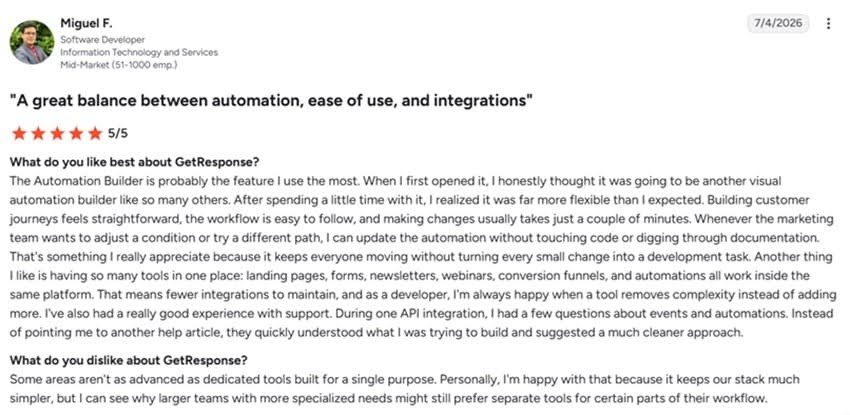
According to GetResponse users, like Miguel below, our platform provides the tools you need to orchestrate personalized customer journeys while remaining user-friendly.
Other features
- Contact scoring and tags – Score customers based on specific actions they take, like how often they buy, pages they visit, and the campaigns they open. Tags let you label customers for better profiling and segmentation. It helps you send targeted email campaigns more effectively.
- Intuitive workflow editor – GetResponse offers a visual automation builder with drag-and-drop functionality. This simplifies workflow creation. No coding required. We also provide a library of prebuilt automation workflows for the different stages of the buyer journey.
- Multichannel marketing automation – Automate email, SMS, and push notifications from a single platform. GetResponse also allows you to create and manage Meta and Google ads within the platform. This eliminates tool hopping and expensive additional subscriptions.
- Ecommerce integrations – GetResponse supports one-click integration with ecommerce platforms like Shopify, WooCommerce, PrestaShop, Magento, BigCommerce, and Shoper.
- Marketing tools – Create signup forms, pop-ups, landing pages, and websites within GetResponse. There are also templates to help you get started faster.
- Revenue attribution – Get actionable insights to track the performance of your automated campaigns. Revenue attribution lets you monitor how much revenue each automated workflow generates.
Pricing
GetResponse pricing starts at $15.58 per month for 1,000 contacts. This plan supports unlimited monthly email sends, welcome series, and one custom automation workflow. It’s ideal if you’re just getting started.
The best package for most online retailers is the Marketer plan, which starts at $48.38/mo. The plan includes advanced customer segmentation, unlimited web push notifications, sales funnels, abandoned cart recovery, and promo codes and revenue reports.
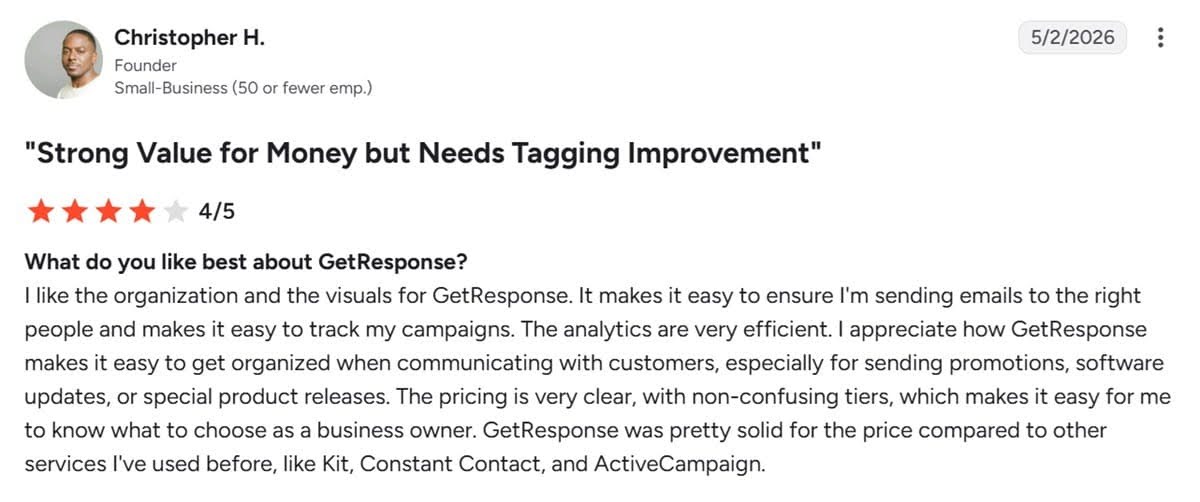
At $48.38/mo for unlimited monthly email sends, GetResponse is one of the most affordable ecommerce marketing solutions on the market. More affordable than ActiveCampaign and Constant Contact, as Christopher explains below.
AI-powered product recommendations, SMS marketing, mobile push notifications, and transactional email campaigns are available on the enterprise plan. This plan includes a dedicated sending domain and IP address for optimal deliverability. The price is customized based on your needs.
3. Nosto – Best for ecommerce search and merchandising
Nosto is a lot like Bloomreach and Algolio in that it supports personalized ecommerce search, category merchandising, and product recommendations.
However, the platform also offers several AI agents and personalization tools like dynamic bundles, behavioral pop-ups, and content personalization.
Nosto’s personalized search tool takes ecommerce search beyond keywords. The built-in artificial intelligence can understand the intent behind every search, even when the standard keywords are not used.
And beyond returning relevant results, Nosto also lets you customize the search experience. You can tailor the results to return specific products based on factors like stock levels, profit margins, and conversion rates.
This allows you to create a search experience that aligns with both the customer’s needs and your business goals. You can tailor the search results to prioritize and offload excess inventory of a particular product line, for example.
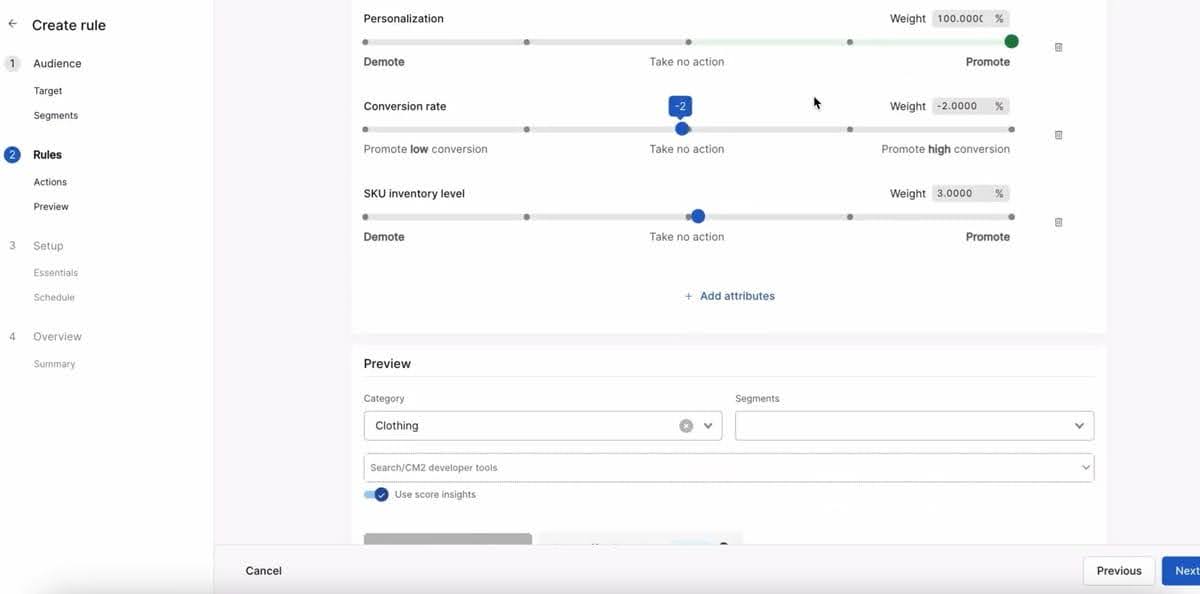
Nosto’s category merchandising lets you fine-tune product sorting. You can personalize category pages by customer segments or individual shoppers based on what you know about them.
For example, you can customize the homepage to support your replenishment campaigns by showing returning website visitors products they’ve bought before.
Dynamic bundles are designed to give your customers tailored “shop the look” options. You can customize these bundles manually or let Nosto’s automation do it for you.
The platform offers predictive, semantic, generative, and visual AI capabilities. Predictive AI analyzes past customer, behavioral, and transactional data. It then forecasts future behaviors and needs, to which you can adapt your shopping experience.
Semantic AI helps the search and product discovery algorithm understand customer queries and intent. The AI also enhances the search experience through auto-suggestions, where it proactively suggests relevant phrases or words as the customer types.
Generative AI helps with creating copy, while visual AI identifies products based on their visual appearance. It then recommends products based on the colors and patterns a shopper has shown interest in.
For example, if a customer is looking at a dress of a particular color, the cross-sells update automatically to complement the color the shopper is looking at.
Other features
- Email marketing – Nosto supports ecommerce email marketing campaigns. It personalizes emails based on the customer data that already lives on the platform.
- Data engine – Collect customer, product, and content data within Nosto. You can also connect the platform to a third-party data source, including offline data, for enrichment. You can then use the data to deliver a curated shopping experience.
- UGC management – Add UGC content from social to your website and email campaigns through Nosto. The user-generated content management platform also provides workflows to get usage rights from content creators. Plus, it supports shoppable UGC campaigns.
Pricing
Nosto pricing is not publicly available, but plans usually include a base platform fee and a fixed fee based on your needs.
Ultimately, the exact figure you pay depends on your business needs (traffic and gross merchandise value), the modules you choose, and the level of support you require.
4. Insider One – Best for customer data management and activation
Insider One is an AI-powered customer engagement platform. It comes with a built-in customer data platform (CDP) that unifies customer information to help you better understand your customers and deliver 1-to-1 experiences.
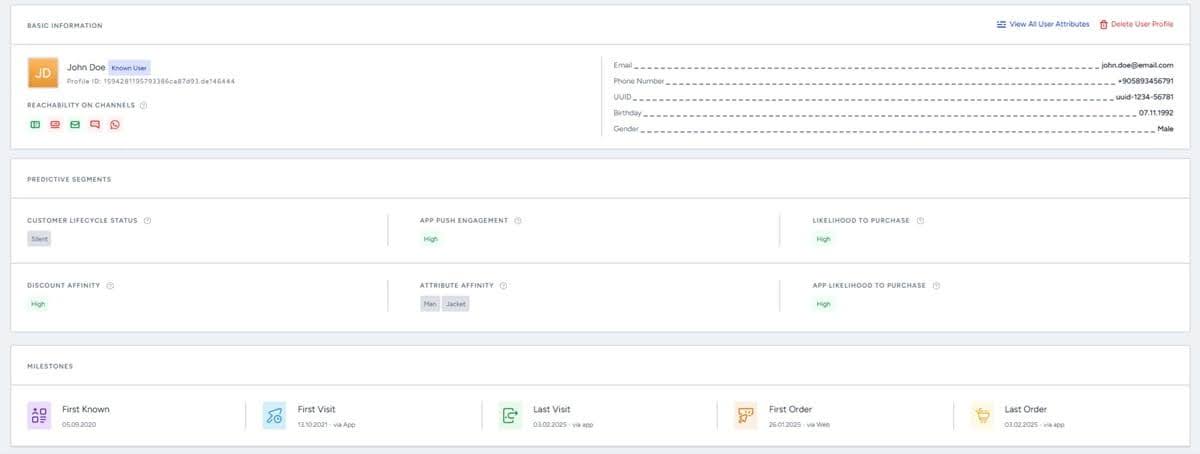
The CDP connects to business tools like CRMs, paid ads tools, social media, and analytics solutions. It also supports data enrichment with Insider One’s built-in data warehouse.
The data solution allows you to create unified profiles, segment customers, and orchestrate customer journeys.
You can use Insider One to segment customers based on CRM attributes and past purchases, for example. The personalization engine then lets you target the customers with tailored campaigns across various channels, including email, SMS, web push, app, and WhatsApp.
Other features
- Agent One – The self-improving AI measures performance, analyzes what worked, and adapts customer journeys to hit your business goals. Agent One Audiences interacts with customers to help them find the products they need. It also offers customer support and updates customer profiles based on insights from the conversations.
- Cross-channel journey orchestration – Create a single workflow that engages customers across various channels. It includes several prebuilt journeys for various use cases and industries.
- Reporting and analytics – Get actionable insights into campaign, touchpoint, and channel performance. It also lets you build custom reporting dashboards.
Pricing
Insider One pricing is not publicly available on their website. However, Capterra reports that pricing starts at £1,000 or roughly $1,300 per month.
How to choose an ecommerce personalization solution
The first thing you must consider is the specific customer touchpoint you want to personalize.
There are different ecommerce personalization tools specializing in different use cases.
For example, Bloomreach and Nosto are ideal if you want something that personalizes your ecommerce search function and product discovery.
GetResponse is ideal when the priority is to personalize your marketing campaigns. Our platform specializes in lifecycle marketing, so we provide specific features tailored for email, SMS, and push notification campaigns.
For example, in addition to personalization features like dynamic content and contact tagging, we offer a solid email sending infrastructure. This guarantees inbox placement, so your marketing and transactional campaigns don’t end up in the spam folder.
The infrastructure can accommodate up to 5 million email sends per hour with a 99% email deliverability rate. That makes GetResponse ideal even for enterprise ecommerce brands.
Then you have a solution like Insider One, which is great if you have a data silo problem. You can’t deliver personalized experiences if customer data is scattered across multiple solutions. Insider One solves that problem by unifying customer data.
With that in mind, here are the critical features to look for when picking an ecommerce personalization solution.
- Analytics and reports – The tool you choose must provide actionable analytics showing the performance and ROI of your personalization efforts.
For example, GetResponse supports revenue attribution. It shows how many sales come from specific campaigns and workflows. Insider One lets you track granular performance, like revenue and engagement, by channel and touchpoint.
- AI recommendations – Choose an ecommerce personalization tool that has a self-learning AI that tracks customer behaviors and attributes and matches them with your product offerings.
- A/B testing capabilities – The best personalization platform lets you A/B test different personalization techniques. This ensures you make data-driven decisions when tailoring the customer experience.
- Integrations – Make sure the platform connects with the critical business tools your online store uses. For starters, it must support seamless integration with the ecommerce platform your store is built upon.
Personalize your ecommerce marketing campaigns with GetResponse
Ecommerce personalization tools fall under different categories based on the specific customer touchpoint they personalize. Some tools focus on personalizing the search and product discovery experiences.
Other software personalizes marketing campaigns across channels like email, SMS, social media, WhatsApp, and push notifications. Then you have tools that unify and put customer data into use to deliver personalized experiences.
GetResponse is built from the ground up to automate and personalize your marketing campaigns across the entire customer journey. Our solution tracks how shoppers browse your store, add items to cart, and engage with your campaigns.
It then lets you send tailored product recommendations and marketing messages based on each customer’s behavior. This increases customer lifetime value and builds loyalty.
Try our marketing automation solution for free today. No credit card required.
Personalization software for ecommerce brands FAQs
1. What is ecommerce personalization?
Ecommerce personalization is tailoring the customer experience such that shoppers see products and marketing content that aligns with their preferences and needs. It requires the use of personalization tools like Bloomreach, Insider One, and GetResponse.
2. What is the best ecommerce personalization software?
The best ecommerce personalization software depends on the touchpoint you want to personalize. GetResponse is great for personalized omnichannel marketing. Tools like Bloomreach and Nosto personalize product discovery and ecommerce search.
