
Shoppers planning gifts with AI tools should specify their budget, deadline, location, product names, and recipient preferences. Retailers can support discovery with clear product information, then build relationships through useful sign-up offers and relevant follow-ups. Shoppers should confirm final prices and delivery details before buying.
Why AI gift planning needs more than “a gift for Dad”
AI gift planning needs constraints: who the gift is for, what they enjoy, what they own, and what you can actually buy.
Ask ChatGPT what to get a father for his sixtieth, and it may hand back a watch or a weekend away. “My dad, sixtieth birthday” leaves the assistant guessing about almost everything that makes your father different from someone else’s.
That’s why the suggestions can read as if they came off the back of a greeting card. The gift worth giving lives in the details the request left out.
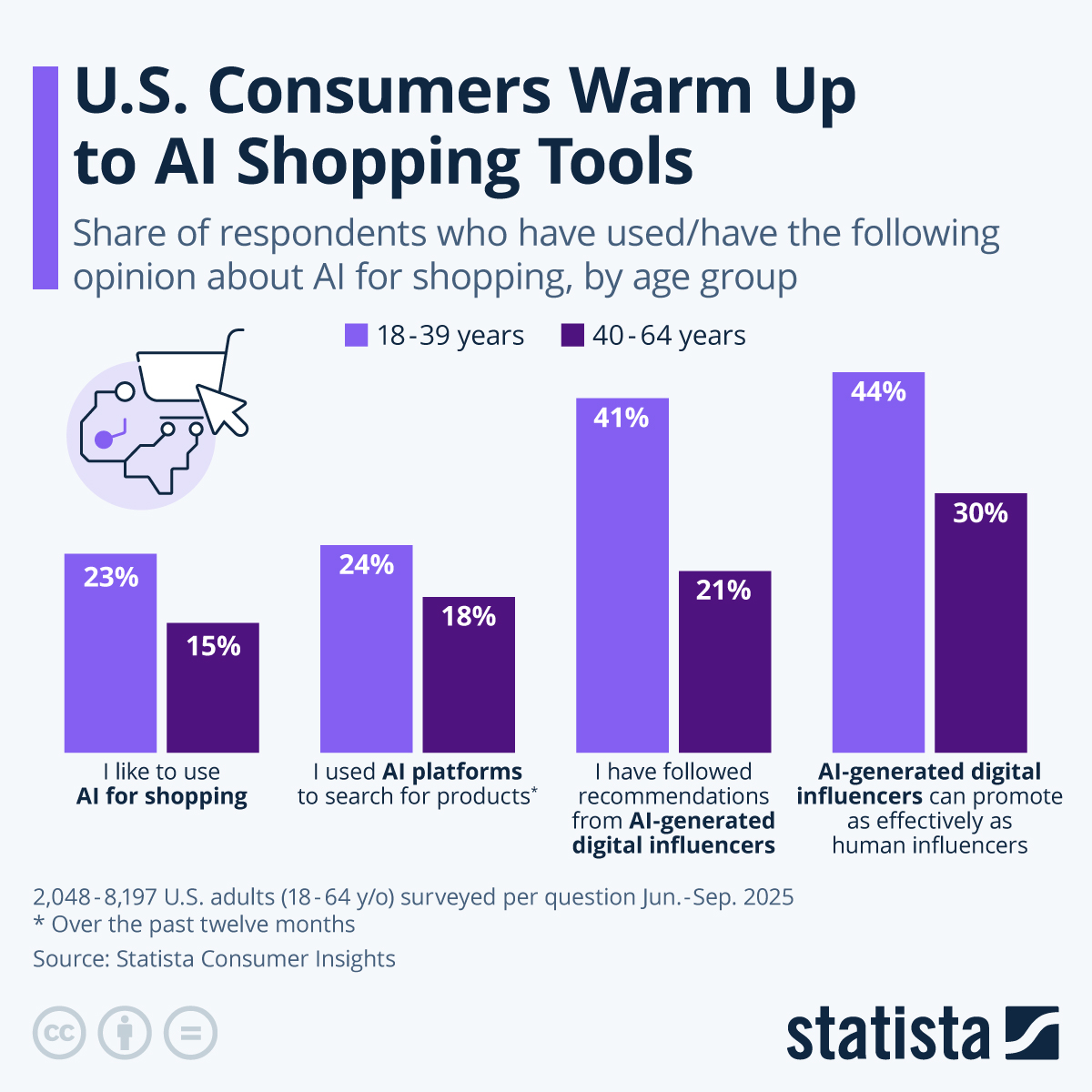
Source: Statista Consumer Insights. U.S. adults aged 18–64 were surveyed June–September 2025; the chart compares two age groups. These are general shopping findings, not a survey specifically about gift planning.
Someone types “gift for my wife, she likes cooking.” One data point, one enormous bucket. Back may come the cooking-gift canon: a Dutch oven, a good chef’s knife, a subscription box, a class downtown.
Add that she already owns a Le Creuset, bought a Shun santoku last year, and keeps saying she wants to get better at bread. The list narrows toward a banneton, a bench scraper, a copy of Tartine, or a baking steel that fits her oven. These are illustrative possibilities, not a verified shopping list.
The model didn’t get smarter between those two prompts. It got more to go on.
Bryan Henry, president of PeterMD, draws a parallel with patient intake:
“In men’s health, the quality of the care tracks the quality of the intake. A patient who writes ‘I feel tired’ gives us almost nothing. One who tells us his energy craters at 3 p.m., his sleep is broken, and his last total testosterone came back at 240 gives us somewhere to start. Specifics are what separate a generic protocol from a treatment plan that fits the man in front of us.”
Before you start, have an assistant available for brainstorming and gather the recipient’s preferences, your spending limit, and your deadline. For current offers, use a tool with web access or provide retailer links and product details yourself.
Step 1: Set a gift budget with a currency and total limit
An AI gift budget should state the currency and total spending ceiling, including shipping, taxes, and any personalization you need.
Without a budget, the assistant can hedge. It offers a cheap pick, a middle pick, and a splurge, because it has no way to tell which bracket is real.
“Under US$40 for a coworker’s Secret Santa” and “around US$500, tenth anniversary” are different briefs. The number helps separate them. One might point toward a candle or a desk plant that survives neglect; the other leaves room for a more substantial gift or experience.
Be clear about whether the limit is per person or for the whole list. For several recipients, give the assistant an overall ceiling and ask it to allocate an amount to each person before suggesting products.
For example: “My limit is US$40 total for one coworker, including tax and delivery. Exclude subscriptions and anything that needs extra accessories.” The amount is an illustrative budget, not a current product price.
Gregor Emmian of Rise uses a trading analogy to explain why a number matters:
“A trader who tells me he wants to ‘get into crypto’ has told me nothing I can act on. One who says he’ll buy Bitcoin if it breaks 62,000 and set a stop at 58,000 has given me a plan with edges. The number is the whole thing. Without it, there is nothing to execute, only a mood.”
The budget also decides what the assistant should leave out. A US$40 ceiling means the reply shouldn’t spend three sentences on a US$300 espresso machine. Ask it to flag any option whose total cost it cannot confirm, then check the amount at checkout.
Step 2: Give the arrival date and delivery location
AI gift prompts need an exact arrival date and delivery location so suggestions can be checked against shipping or pickup options.
“Needs to arrive by Saturday” leaves room for confusion. Say “It must arrive in Boston, Massachusetts, by December 18, 2026; local pickup is fine.” A city or postal area is enough to begin comparing options; enter your full address on the retailer’s site when confirming delivery.
A short deadline may rule out custom products, overseas shipping, or a ten-day engraving queue. Ask the assistant to separate ready-to-ship gifts from made-to-order items and identify any unconfirmed lead times. Naming a deadline does not guarantee the assistant will find an available product.
This is where AI gift planning can come apart in practice. Imagine asking in early December, getting a good idea, and ordering it before noticing that the estimated delivery is December 27. A useful idea still needs a delivery check.
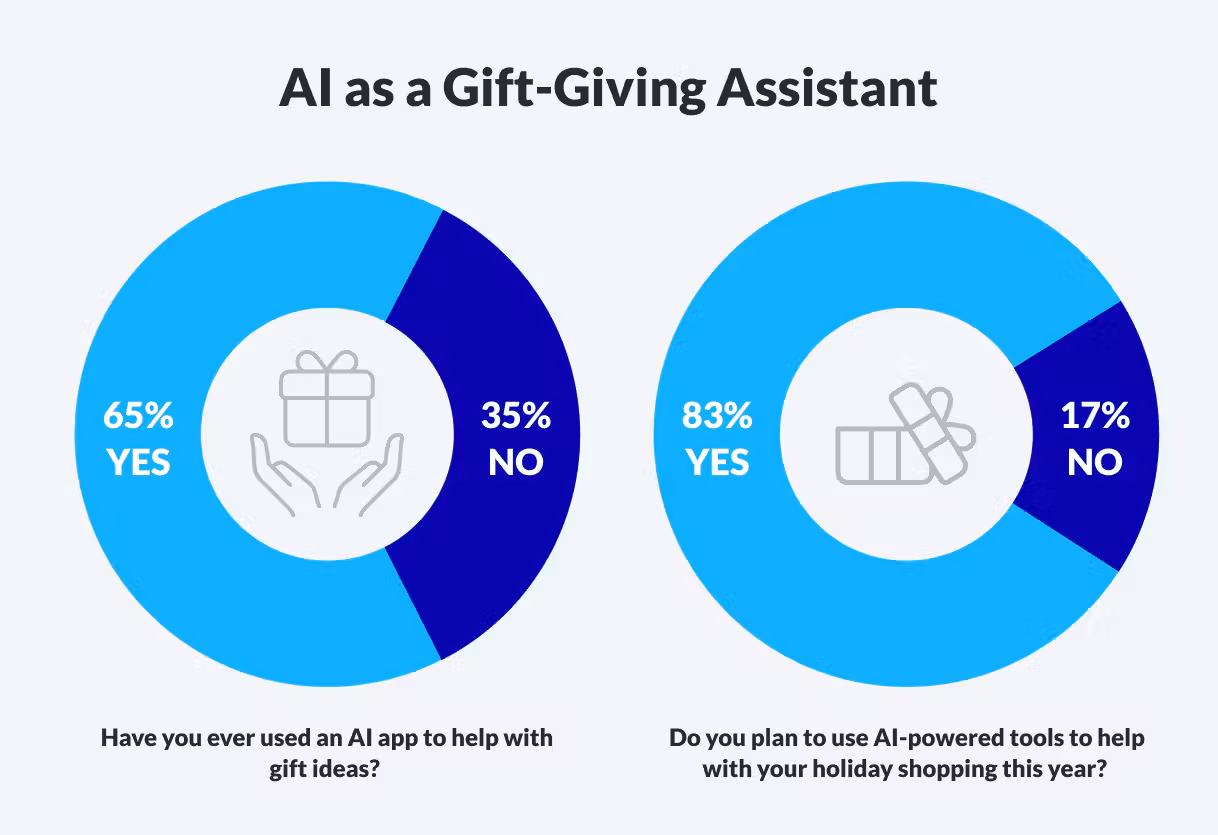
Source: Zeta Global, report published October 28, 2025, based on a survey of 2,000 consumers who use AI tools at least monthly. The holiday plans shown refer to 2025, and the findings do not represent all shoppers.
Some dates carry more than logistics. A tenth anniversary and an ordinary anniversary may call for different gifts. Tell the assistant what the milestone means to the recipient, rather than expecting it to infer the emotional weight from a number.
Step 3: Name the exact product, model, and quantity
Exact product names give an AI shopping assistant a reference point; model numbers, variants, and quantities help prevent mismatched suggestions.
A category makes the assistant guess inside the category. A product name gives it a coordinate to work from.
“Noise-canceling headphones” is a bucket. “He’s been eyeing the Sony WH-1000XM5” gives the assistant a coordinate to work from. You can ask for that exact model, alternatives within budget, or a compatible accessory. Say which you want.
Copy the model number from the manufacturer or retailer. Add the size, color, capacity, or generation when it changes what you’re buying. A case that fits one pair of headphones may not fit another, even when the names look similar.
Tell it someone loves their Baggu crossbody and you have given it a starting point. Add the exact style and dimensions before asking for an organizer insert. “She likes bags” leaves much more to guess.
Quantity is a spec like any other. Someone planning matching shirts for a family reunion should say it’s a run of thirty, with a size breakdown and a total budget. That changes the search toward suppliers of bulk t-shirts. Blank shirts and printed shirts are different orders; check customization costs and production time separately.
The same move works for ruling things out. “He already has an AeroPress and a Baratza grinder, skip coffee gear” spares everyone the obvious recommendation he’s already bought a better version of. Naming what someone owns is as useful a filter as naming what they want.
Step 4: Describe the recipient’s habits and taste
Recipient preferences make AI gift ideas more specific when you describe habits, existing possessions, practical frustrations, and the style someone actually uses.
“My sister” stands in for a whole person the assistant can’t see. She’s thirty-four. Just closed on the first place she’s owned. Posting about the vegetable garden she’s starting. Mentioned last month that she never has a decent jacket for the in-between weather.
That’s four facts, and each opens a direction: housewarming, gardening, a transitional-weight coat, something for the new house she’d never buy herself. You still have to decide which direction feels right.
The complaints can be useful fuel. People telegraph what they want by what irritates them: the friend whose phone is dead by two in the afternoon, or the brother who grumbles that his knives are dull every time he cooks.
Hand the assistant “his earbuds die halfway through his commute, and it drives him up the wall.” Then add the phone model, preferred fit, and budget. Those details make a replacement suggestion easier to evaluate than “what do guys like?”
Taste is harder to pass along, and it repays the effort. The colors they actually wear, as opposed to the ones hanging unworn in the closet. The three brands already in rotation.
“She wears a lot of oatmeal and rust, nothing shiny, everything natural fiber” gives the assistant something concrete to work with. Keep the budget alongside it. Taste and price answer different parts of the brief.
Andrew Bates, COO of Bates Electric, says: “People rarely describe what they want, but they constantly describe how they live. The habits, the small frustrations, the things they never get around to buying for themselves. Those details are what turn a generic suggestion into a gift that feels like it came from someone who knows them.”
An AI gift prompt you can adapt
A useful AI gift prompt combines the recipient, budget, deadline, location, product details, and exclusions, then asks for a short, checkable comparison.
The following is an illustrative brief. Replace the personal details, amount, and date with your own before sending it:
“Help me choose a birthday gift for my father, who is turning sixty. He likes baking bread, owns a Le Creuset Dutch oven and a Shun santoku, and dislikes decorative kitchen gadgets. My budget is US$80 total, including tax and delivery. It must arrive in Boston, Massachusetts, by December 18, 2026; local pickup is fine.
“Suggest three options. For each, explain why it fits, give the exact product name and relevant size or model, and list the retailer link, item price, shipping cost, and arrival estimate if you can verify them. Label anything you cannot confirm. Exclude subscriptions, duplicate equipment, and products over budget. Ask me a follow-up question if a missing detail would change your suggestions.”
If the assistant cannot browse current retailer pages, ask for gift categories and selection criteria instead. You can bring back links to actual products and ask it to compare the details you supply.
Requesting three options is a practical starting point, not a proven optimum. A compact comparison makes it easier to spot a broken constraint, such as the wrong size or an arrival estimate that falls after the birthday.
Refine the first answer before choosing a gift
An AI gift shortlist is a draft: correct the weak matches and ask the assistant to compare the remaining options against your original constraints.
The first list is the assistant showing what it understood, which is useful as something to correct. You don’t need to start the conversation over.
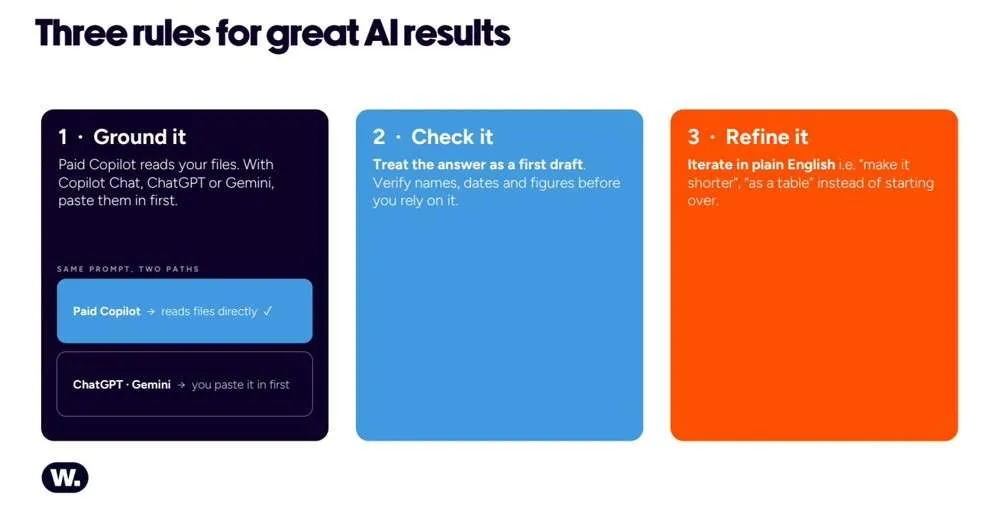
Source: Wellingtone. The ground, check, and refine workflow applies to gift suggestions. The diagram’s file-handling comparison is not a current feature guide: ChatGPT supports file attachments, with availability depending on the plan and environment.
Push back with something the assistant can act on. “She’d find the second one boring, she’s more function than decoration.” “That’s over budget, what’s the closest thing at half the price?” “Keep the bread-baking idea, but remove anything she already owns.”
Each exchange supplies a constraint the first prompt was missing. Ask the assistant to explain why an option fits and identify its weakest match. A gift can meet the price limit and still miss the person.
A useful final request is: “Compare the remaining three options by total cost, confirmed delivery information, compatibility, and return policy. Mark missing information rather than guessing.” The resulting table is a checklist for your review, not proof that every detail is correct.
Lankitha Wimalarathna, founder and CEO of Hiveage, says, “A good gift has never been about the object. It’s evidence that someone was listening. Software can search every shelf on earth in a second, but it can’t decide what matters to the person you’re buying for. That decision is still yours, and the more of it you put into words, the more the tool can do with it.”
Check the retailer’s details before you buy
AI gift suggestions still need a retailer check for the final price, exact variant, stock, delivery estimate, and return conditions.
None of this makes the assistant know the person. It can process what it’s handed. It can’t feel the room. A practical present might be welcome from a close friend and awkward from a colleague. That judgment remains yours.
Its other limit is the evidence available. A shortlist may contain an outdated offer, a mismatched accessory, or an estimate that does not apply to your location. A confident sentence is not a delivery confirmation. Even a product link needs opening.
- Price: confirm the currency and total, including taxes, shipping, personalization, and required extras.
- Product: check the model, size, color, condition, included accessories, and manufacturer’s compatibility information.
- Delivery: enter the destination on the retailer’s site and check processing time, arrival estimates, and pickup availability.
- Returns: read the return window, gift-receipt options, return costs, and exceptions for personalized products.
For an experience, check the location, booking availability, expiry date, and whether the recipient will face extra charges. For a subscription, check the renewal terms and whether payment details are required.
What the assistant can help with is the legwork once the judgment is made. Use the conversation to build a shortlist you understand, then make the purchase from details you have checked yourself.
Help AI shoppers discover your products
Retailers can support AI-assisted product discovery with accessible product pages, accurate catalog data, and gift guides that answer specific shopping questions.
Every shopper described here is someone a store is trying to reach while they’re deciding. The seller’s side runs on the same rule: sharper inputs give the next person, or assistant, better information to work with.
- Make each product identifiable. Write a useful product description with the brand, model, size, materials, compatibility, and intended use. Show personalization limits and explain what comes in the box.
- Keep the offer consistent. Align prices, currency, stock, shipping costs, and return conditions across product pages and catalog feeds. Distinguish dispatch time from arrival estimates and explain the location and order cutoff behind delivery claims.
- Answer the gift question. Create genuinely useful collections such as “bread-baking gifts under US$80,” with current products and reasons each suits that interest. Link the collection to the exact products and variants, and remove items that no longer meet its promise.
For Google discovery, check that important pages are crawlable, indexed, and linked from your site. Google’s guidance for AI search features emphasizes ordinary SEO fundamentals; it does not require special AI markup. Its product data guidance explains how Product structured data and Merchant Center feeds can supply shopping information. Keep that data consistent with the visible page.
For merchants sharing catalog data with OpenAI, its product data specification calls for current prices and availability, with separate records for product variants. Check the supported submission route and eligibility for your store. Accurate data supports discovery, but neither feeds nor markup guarantee a recommendation.
Give gift shoppers a reason to stay in touch
Retailers can turn a gift-shopping visit into an ongoing relationship by offering useful email updates and collecting the buyer’s stated interests.
If winning a new visit takes more work, the visit needs a useful next step. Someone researching a gift may leave without buying today. Offer a reason to return that matches the page they came for: a downloadable gift shortlist, a buying guide, or updates about a particular collection.
Keep the invitation specific. “Get our bread-baking gift guide and occasional kitchen-gift ideas” tells a visitor more than “join our newsletter.” Let people browse and buy without subscribing, and explain what they are signing up to receive.
GetResponse can support that handoff. GetResponse signup forms support custom fields, while GetResponse popups provide another place to present the invitation. Choose a placement that lets the visitor read the product information first.
Ask one useful optional question: “Shopping for yourself or someone else?” Then offer a choice of interests. Keep the buyer’s preferences separate from the gift category. Someone buying a gardening gift for their sister has not told you they want gardening offers themselves.
Use the answers to inform your list management, tags, and segments. Send a welcome email with the promised guide and an invitation to update preferences. A subscriber who has already received something helpful has a clearer reason to recognize your next message.
Retain gift buyers with relevant GetResponse follow-ups
Retailers can use GetResponse marketing automation to follow up on subscriptions and purchases, with messages shaped by gift-buying context and stated preferences.
GetResponse marketing automation supports workflows based on customer data and behavior. Connect your store and check that the required customer, cart, and purchase data reaches your account before building a sequence. Feature availability depends on your plan, integration, and tracking setup; check the current GetResponse plan details.
- Welcome the subscriber. Deliver the promised shortlist and ask which gift categories or personal interests they want to hear about.
- Follow up on an unfinished purchase. Where cart recovery is available and the contact is eligible for the message, link to the saved items. Stop reminders when the order is completed, and keep stock and delivery claims current.
- Help after the sale. Send useful care, setup, or gift-exchange guidance through the appropriate customer communication. Time review requests so the buyer has had a chance to receive and give the gift.
- Make the next offer relevant. For subscribers who opted into marketing, choose a compatible accessory, a new item in a selected category, or an occasion reminder they requested. Let people change interests or pause seasonal messages.
For example, a proposed bread-baking sequence could deliver a gift guide at signup, follow a purchase with care instructions, and later offer gift ideas in categories the buyer selected. That is an illustrative workflow, not a reported customer result. After a purchase, remove the buyer from the unfinished-cart branch.
The GetResponse AI Email Generator can draft emails and subject lines; its AI assistant helps write and adjust email text. Give the first prompt the audience, actual offer, product details, and deadline. Review every draft before sending.
Measure the sequence through signup rate, completed purchases, unsubscribes, and repeat purchases. Where referral data is available, compare AI-referred visitors with other sources. Judge retention by return purchases over a period that fits your buying cycle; an email open alone does not establish a retained customer.
Frequently asked questions about planning gifts with AI tools
AI gift planning needs a clear brief and a final retailer check. These answers cover the details to provide and the limits to keep in mind.
What should I include in an AI gift prompt?
Include the recipient’s interests, existing possessions, dislikes, total budget and currency, exact arrival date, and delivery location. Add model numbers, sizes, or quantities when relevant, and ask the assistant to flag details it cannot verify.
Can AI find gifts within a budget?
AI can suggest gifts within a stated budget, but you should confirm the final total with the retailer. Include tax, shipping, personalization, and any required accessories in your spending limit.
Can AI guarantee that a gift will arrive on time?
No. Give the assistant your arrival deadline and delivery location, then confirm the estimate on the retailer’s site. Check processing time separately from transit time, especially for personalized gifts.
How do I make AI gift ideas more personal?
Describe what the recipient actually does, wears, owns, or complains about. Add specific likes and exclusions, then correct suggestions that miss their taste or practical needs.
Can I use AI gift planning without sharing private details?
Yes. Describe interests, general life stage, and preferences without including a full name, home address, or sensitive personal history. A city or postal area can support initial research; confirm delivery using the retailer’s checkout.
How can retailers improve product discovery in AI-assisted shopping?
Keep product names, variants, prices, stock, delivery conditions, and catalog feeds accurate. Make important pages accessible to search, answer specific gift questions, and follow each platform’s product-data requirements. These steps do not guarantee inclusion in AI recommendations.
How can retailers retain shoppers who find them through AI?
Offer a useful reason to subscribe, ask whether the purchase is a gift, and collect the buyer’s own interests. Use those preferences and purchase data for relevant welcome, purchase-support, and repeat-purchase messages. Promotional follow-ups should go to people who opted into them.
