
The best Black Friday email campaign examples combine a clear offer, recognizable design, and a reason to act. For 2026, coordinate email, consent-based SMS, and store automations around Black Friday on November 27 and Cyber Monday on November 30. Start with the customer’s next step.
Black Friday 2026: dates and a store campaign calendar
Black Friday 2026 is November 27, and Cyber Monday is November 30; plan previews, launch messages, and follow-ups around those dates.
The dates follow the U.S. Thanksgiving calendar; Best Buy’s Black Friday page also identifies November 27 for the 2026 event. Set your own sale’s start, finish, and time zone before scheduling messages. Your promotion does not have to last the whole weekend.
| When | Email campaign | SMS and automation |
|---|---|---|
| November 16–22 | Preview the offer, collect preferences, and introduce a gift guide. | Invite eligible email subscribers to an explicit SMS signup; test consent and store-event syncing. |
| November 23–25 | Open early access to the promised VIP or loyalty segment. | Text opted-in VIPs when their access opens; exclude customers who already bought from repeat purchase prompts. |
| November 26–27 | Send a relevant Thanksgiving message or launch the Black Friday offer. | Use SMS for a timely launch or genuine deadline, with local-time sending controls. |
| November 28–29 | Highlight useful bundles, gift categories, or remaining stock. | Run eligible cart-recovery flows; check purchases and inventory before each reminder. |
| November 30 | Send the Cyber Monday offer and its real closing time. | Coordinate the final reminder with email and your contact-frequency limit. |
| December 1 onward | Move buyers into order care, product education, and relevant follow-ups. | Stop expired offers and recovery prompts for completed orders; keep marketing permission checks active. |
This is a planning example, not a requirement to send every message to every subscriber. Choose the moments that fit your offer and normal sending cadence. Schedule in the audience’s local time where your platform supports it, and avoid a sudden jump in volume to inactive contacts.
The campaign examples are archived creative, including newer 2025 examples from Immi and Everlywell. Older screenshots retain their original dates and prices. Those offers are historical, and the examples illustrate messaging choices rather than proven sales results or announced 2026 promotions.
Black Friday email examples that build early interest
Black Friday preview emails give subscribers a reason to plan ahead, especially when early access or a direct-purchase benefit is genuinely available.
1. Apple: make the shopping window easy to understand

Waiting until Black Friday to send your campaign’s first email leaves little time to build interest. Using a drip campaign can introduce the offer before your sale. This email from Apple clearly outlines the brand’s upcoming Black Friday and Cyber Monday deals in the archived campaign.
Another thing this email does well is offer an additional gift card for shopping directly through Apple. For a brand that sells through multiple other channels, sending this extra incentive ahead of time gives customers a reason to shop directly. For your store, state the qualifying products, spending conditions, and gift-card terms together.
2. Ray-Ban: give loyal customers meaningful early access

In a world where new customers often get the best treatment, using Black Friday to give some love to returning buyers is a smart play. Ray-Ban offered exclusive early deals to its The Ones community in this archived campaign.
The early access encourages people to stay members by making subscribers feel special. Build a loyalty segment, send its access link before the public launch, and make sure the website honors the promised access window. An SMS reminder belongs only with members who also agreed to marketing texts.
3. Soundstripe: put the offer and eligibility together

Urgency is a key tactic for Black Friday sales, but it can come across as too aggressive if you’re not careful. Soundstripe pairs early access with a large discount and explains that it applies to yearly plans.
In addition to the large discount, Soundstripe makes the eligible yearly plan and checkout code easy to find. Put the same detail near your CTA, using your current offer. Only describe a promotion as your biggest sale if you can support the comparison.
Black Friday offer examples: clear prices, bundles, and gifts
Black Friday offer emails make the value easier to judge when they explain pricing, purchase conditions, and useful shopping categories together.
4. Margin: make stocking up feel useful

Margin made a useful choice by encouraging customers to take advantage of the low prices and buy in bulk. The email went on to suggest that the sale was a time to stock up on products for the year or buy gifts for friends and family.
These suggestions come across as friendly reminders that help customers save money. Instead of requiring a promo code, savings were applied automatically, and customers got complimentary shipping under the pictured offer. If you use a bundle or spend threshold, show what qualifies and check that the margin still works after shipping and returns.
5. The Washington Post: show the billing interval

The Washington Post put a 99-cent offer front and center in this Black Friday email. Using a bold color, large font, and dark background keeps the reader focused on the strongest selling point. From there, a note that the offer is only available for a limited time adds subtle urgency.
The small words matter: the creative says “every four weeks.” For subscriptions, explain the introductory period and renewal terms. For a store, give the same attention to minimum spend, excluded products, and whether a discount requires a code.
6. Adidas: turn the catalog into a gift guide

Adidas took advantage of the gift-buying aspect for this campaign and included free expedited shipping. For a seamless shopping experience, it included visual links to popular gift categories in its online store.
Creating gifting guides for your products positions you as a brand that helps take tasks off your customers’ plates by making holiday shopping easy. For 2026, check your own shipping cutoffs by destination. If you offer buy online, pick up in-store, explain collection times and link to eligible locations.
Black Friday emails with a recognizable brand voice
Black Friday emails stand out when the tone and offer fit the brand, whether that means gratitude, a specific cause, or humor.
7. Astro West: thank customers before asking for a sale

This Astro West email stands out because it starts by thanking customers and then positions the sale as a form of gratitude. Its message connects the business with its community before introducing the offer.
The useful lesson is the order of the message. If Thanksgiving is relevant to your audience, make the thank-you specific to the relationship. You can pair it with a preview or an existing-customer benefit without pretending every subscriber celebrates the holiday.
8. Everlane: explain the cause behind the campaign

Matching your Black Friday offers to your brand’s ethos is one way to create a memorable campaign. In this 2023 example, Everlane connected its Black Friday Fund with support for the Rodale Institute and U.S. farmers transitioning land to regenerative organic farming.
The message gives customers a reason to care beyond the discount. If your store supports a cause, name the organization, explain what each qualifying purchase contributes, and state any cap or campaign window. Distinguish a fundraising goal from money already donated.
9. Hims: keep the voice your customers recognize

Let’s face it. Your email is not the only one customers will get during the holiday shopping season. One way to get attention is to focus on what makes your brand recognizable. Hims uses a lighthearted tone and playful double meanings in this holiday email.
If humor works for you, it can be a tactic to distinguish your message from the other brands popping up in your customers’ inboxes. Keep the joke consistent with your audience and product category. The purchase details and CTA still need to be clear without the reader having to decode the punchline.
Black Friday email design examples for urgency and attention
Black Friday email design can communicate urgency through hierarchy, imagery, and a clear CTA without filling the whole message with competing demands.
10. Moment: balance an urgent message with calm design

This Moment campaign is another example of creating urgency without being too aggressive with language or visuals. The heading “Deals this good won’t last forever” gives readers a reason to act. The supporting text reinforces the message with phrases such as “supplies are limited.”
The language is balanced by calming colors and a simple design that make the urgent phrases come across as good advice from a friend rather than a salesperson shoving discounts in your face. Use a real sale deadline or accurate stock information; a timer that restarts for every visit undermines the message.
11. KIDLY: use animation without hiding the offer

Kidly used fun imagery and a play on words to capture the cute and aesthetically pleasing characteristics that set the brand apart. The falling snowflakes invoke the idea of holiday gift-giving, while the penguins add movement to the email.
Moving elements such as GIFs can draw attention, but keep the offer and CTA understandable in the first frame. Check the message with images blocked and on a small screen. The design should still explain what shoppers get and where to go.
Understanding email design best practices, from image use to font and color selection, gives you a useful starting point. You can also adapt professionally crafted email templates to your brand, then test the resulting email in the clients your subscribers use.
Personalized Black Friday emails and cart reminders
Personalized Black Friday emails narrow the choice using relevant customer data, while cart reminders follow up on a purchase the shopper left unfinished.
12. Udemy: curate recommendations around an interest

This Udemy email shows how you can leverage segmentation to make a campaign feel relevant. It groups courses around software interests instead of sending every subscriber the same selection from a large catalog.
If your brand caters to a wide range of customers and interests, segmentation helps narrow a vast product catalog into a few curated items that resonate with each group. For a store, start with stated product preferences or past purchases, and provide a useful fallback when that data is missing.
13. Columbia: give a price drop one product to focus on

Taking segmentation one step further and leaning into personalization can make your message more useful. Columbia let one product lead this archived price-drop email, with related items underneath.
The language in the email makes it read like a friendly reminder you might get from a store associate who knows what you like. The use of click-to-reveal builds curiosity and encourages readers to engage. The email itself does not prove whether a browse, wishlist, or purchase event triggered it; choose and test a valid trigger in your own store.
14. Pulp & Press: recover a cart with a friendly nudge

Abandoned cart emails can re-engage subscribers with products they already showed interest in. In this Cyber Monday campaign, Pulp & Press playfully reminded customers about forgotten items and used a conditional discount.
The lighthearted nature of the copy and imagery makes this relevant and targeted reminder feel low pressure, which can be a tough balance to achieve on Black Friday and Cyber Monday. Check order status before sending a reminder, link back to the relevant cart, and stop the recovery flow when the order is completed. Keep any incentive within your margin and published sale rules.
Two more Black Friday email examples: SMS signups and a hero offer
Immi and Everlywell’s archived 2025 Black Friday emails show how one focused action can connect a preview message with the next shopping step.
15. Immi: invite email subscribers to join the SMS list
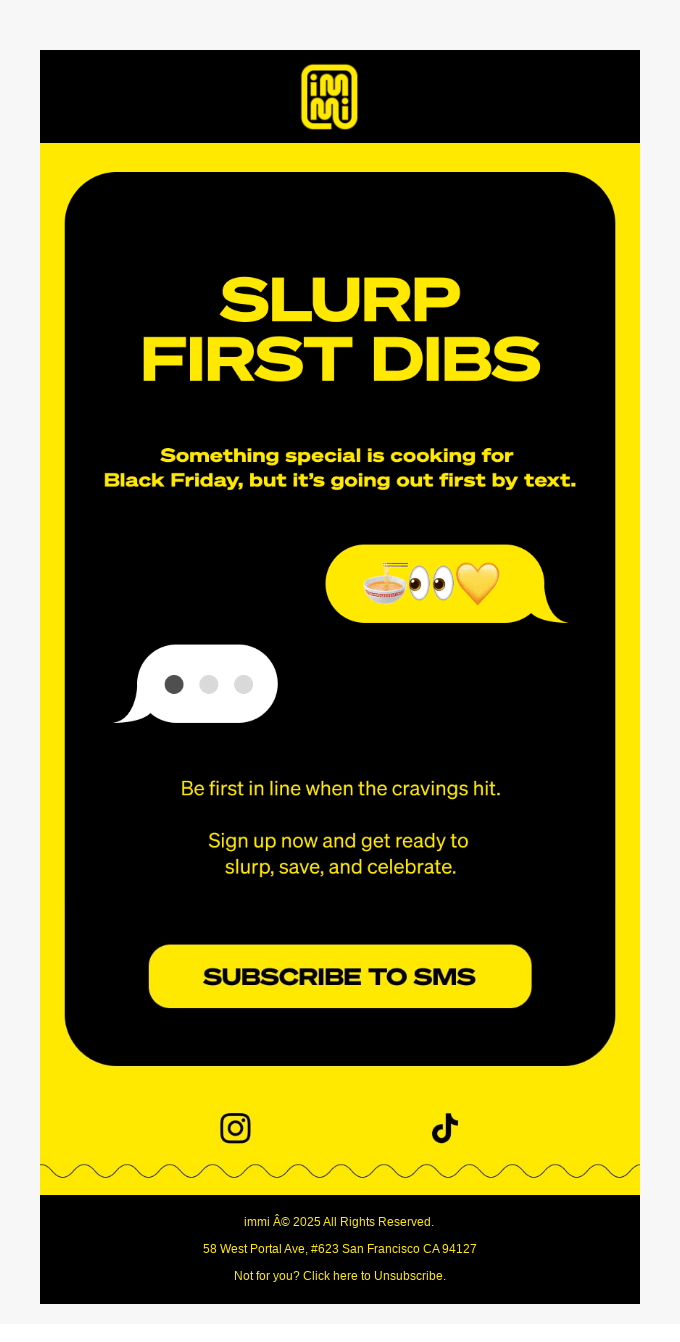
Immi’s preview email asked subscribers to sign up for SMS to hear about the Black Friday sale first. A phone-style design and chat bubbles reinforce the invitation; the CTA asks for one action rather than competing with a product catalog.
For a store, this is a useful way to connect email with an explicit SMS signup before launch. Explain what messages people are agreeing to receive. An email subscription or checkout phone number is not automatic permission to add someone to a promotional text campaign.
16. Everlywell: give the main offer its own space
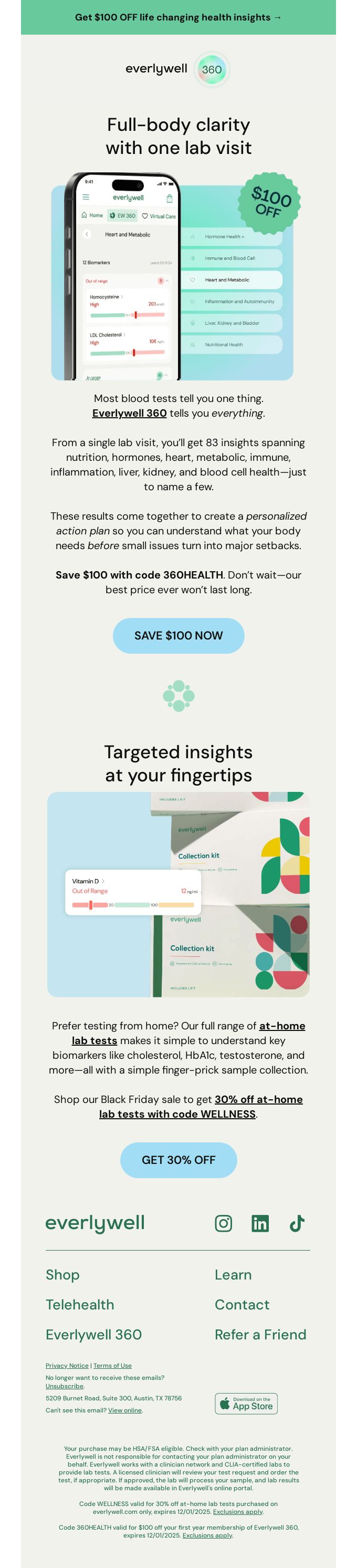
Everlywell led its email with $100 off the first year of its 360 membership, then placed a separate 30% offer for at-home tests lower down. The archived terms expired December 1, 2025; the figures describe that campaign, not a current offer.
The layout gives the main product room to make its case while keeping a second route for other shoppers. Your store could use the same hierarchy for a featured bundle and a category promotion. Give each offer clear eligibility and a destination that matches the email.
Create a coordinated Black Friday email and SMS plan
A coordinated Black Friday email and SMS plan gives each channel a job and limits overlapping messages to the same customer.
Getting a head start with your email campaign helps you build excitement and make your brand top of mind with customers before the sale. Use email for the full offer, product comparisons, and gift guides. Reserve SMS for opted-in customers at a useful moment, such as VIP access opening or an actual sale deadline.
Make the offer clear and keep urgency honest
The one thing you need to communicate is the details of your Black Friday deal: the discount or benefit, qualifying products, and the date range. It’s also helpful to highlight additional benefits such as complimentary shipping or a gift with purchase, with the conditions attached.
“Subtle urgency” may sound like an oxymoron, but it can help you avoid emails that feel like they’re shouting at customers. Pair a real deadline with calm imagery. Avoid fake scarcity, unsupported lowest-price claims, or shipping promises your fulfillment team cannot meet.
Before you offer your biggest discounts, check contribution margin after product cost, shipping, payment fees, returns, and message costs. Bundling products together or explaining the benefits of buying in bulk can make the offer useful without applying the same discount to everything.
Use customer segments across both channels
It’s impossible to craft copy that hits home for everyone on your email list. Useful segmentation strategies include product preferences, purchase history, and personal interests. For personalization, we recommend using relevant customer data to customize each email. A first name alone will not make an otherwise generic offer relevant.
Consider leveraging dynamic content to show a relevant category. GetResponse AI product recommendations are another option where your plan, catalog, and data support them; filter out unavailable products and check the fallback content.
Keep email and SMS permission separate in your audience data. As a permission-based approach, send promotional texts only to people who agreed to them, and honor opt-outs. Rules vary by market: UK ICO guidance explains consent and the limited existing-customer exception for electronic marketing. Check the rules for each destination, including applicable quiet hours and sender registration.
Build Black Friday automations around store events
Black Friday automations need reliable store events, channel permission checks, and purchase-based exits so reminders stay relevant as customers shop.
Using an email automation platform to set up a sequence can help you stay organized while you beat the rush. Connect your store’s catalog, cart, order, and consent data before building the workflow. The example below is an illustrative setup to adapt, not a claim about any featured brand’s actual automation.
Start with these four workflows
- Welcome and early access: confirm the signup, record the promised access window, and send the relevant preview. Keep new SMS subscribers separate from people who opted into email only.
- Cart recovery: after a valid cart-abandonment event, apply a delay and check whether the customer purchased. Send a cart email to an eligible subscriber. Before a later SMS, check SMS consent, local sending time, recent messages, stock, and the offer’s expiry again.
- Purchase follow-up: remove the completed order from cart recovery. Route the buyer into order care and useful product information, keeping any further promotions subject to the appropriate permission.
- Final call: send a reminder only while the offer is available. Exclude recent purchasers from repeat prompts for the same purchase, and stop the campaign when the real deadline passes.
Choose delays and frequency limits using your normal cadence and customer behavior; there is no universal best send count. A click or purchase is a more useful workflow decision than assuming an email open proves interest. Coordinate broadcast campaigns with triggered messages, not just with each other.
GetResponse marketing automation supports store-data connections, behavioral targeting, and abandoned-cart email sequences. GetResponse SMS marketing can add triggered texts. Check your subscription, supported markets, sender setup, SMS charges, and integration requirements before launch.
For GetResponse’s separate Ecommerce Abandoned Cart campaign, the setup guide explains store integration, native marketing-consent requirements, and the purchase exit. Avoid running that recovery campaign alongside a second automation for the same cart: duplicate reminders can reach the same customer.
Test the mobile journey and measure store results
Black Friday campaign testing should cover the email, SMS, landing page, cart, and purchase exit; store results need more context than open rates.
Check what shoppers actually see
To make the most out of Black Friday and Cyber Monday, ensure that your emails are mobile optimized, especially your CTA buttons. Using a responsive design helps your campaign adapt to screens and devices of different sizes. Check the result on real devices. Keep the discount, deadline, and main action available as live text rather than only inside an image.
Follow every CTA through to checkout. Test automatic discounts, coupon rules, variant availability, shipping eligibility, pickup locations, and the cart-recovery link. Check personalization with a missing first name or an empty recommendation block. Send a test purchase and confirm that the recovery messages stop.
For SMS, preview the full message, sender identity, tracked link, and supported opt-out method. Check the message-segment count and destination charges before sending; a short-looking text is not necessarily billed as one segment. Test local-time controls and the suppression list too.
Measure beyond the first order
Use consistent campaign tags and review clicks, conversion rate, orders, average order value, recovered carts, and contribution margin after discounts and messaging costs. Check complaints and unsubscribes alongside revenue. Do not add together email- and SMS-attributed orders without checking whether both channels claimed the same purchase.
Compare customer segments and include a holdout group where practical to estimate incremental results. After the sale, stop expired offers and help new buyers use what they purchased. Keep a distinct plan to drive more Black Friday and Cyber Monday sales while protecting the relationship after the weekend.
GetResponse MAX combines email, SMS, and marketing automation with ecommerce capabilities for teams that need an enterprise solution. Book a demo to check fit, availability, and costs for your store.
Black Friday email marketing FAQs
Black Friday email marketing works best when the offer, customer segment, channel permission, and store journey are planned together before the sale starts.
When are Black Friday and Cyber Monday in 2026?
Black Friday is November 27, 2026, and Cyber Monday is November 30, 2026. Publish your own promotion’s start, end, and time zone so the email, SMS, and checkout show the same terms.
When should a store start its Black Friday email campaign?
Start before the sale with time to collect preferences, test the shopping journey, and deliver any promised early access. For a 2026 planning example, use November 16–22 for previews and November 23–25 for eligible VIP access; adapt the schedule to your audience and offer.
How many Black Friday emails and SMS messages should I send?
There is no universal best number. Plan around meaningful moments such as early access, launch, a cart reminder, and a genuine deadline, then apply a shared frequency policy and remove customers from reminders that no longer fit.
Can I send Black Friday texts to everyone on my email list?
Do not treat email permission as automatic permission for promotional SMS. Use a separate, explicit SMS signup, retain permission records, honor opt-outs, and check the rules and provider requirements for each destination.
Which automations should an online store prepare for Black Friday?
Prepare welcome and early-access messages, eligible cart recovery, purchase follow-ups, and a final reminder tied to the real offer deadline. Check order status and channel permission before follow-ups, and stop cart recovery when the customer buys.
Are the offers in these Black Friday examples available in 2026?
The featured messages are archived campaigns used for creative inspiration, including 2025 examples and older screenshots. Their pictured discounts, prices, codes, and deadlines are historical; check each retailer for current offers.
