
Can I segment my contacts based on ecommerce data?
Ecommerce conditions let you segment contacts based on their shopping habits: what products they bought, what brands they chose, how many times they bought items from your store or stores, and how much they spent. These conditions apply to contacts with ecommerce data in your account.
As of January 2026, a new segmentation version is available. It is being gradually rolled out to existing accounts and is already set as the default for all newly created accounts.
The new version can be identified by the BETA label.
The steps outlined in this article apply exclusively to accounts with access to the new segmentation. If your account does not yet have access to the new segmentation, you can find the instructions below in the section titled Steps for old/legacy segmentation.
To find and segment your contacts:
- Go to Contacts > Segments (BETA).
- Click Create segment.
- In the Create segment by yourself section, click Create.
- On the segment creation page, click Select a condition, then hover over Purchase behavior to display the available ecommerce conditions.
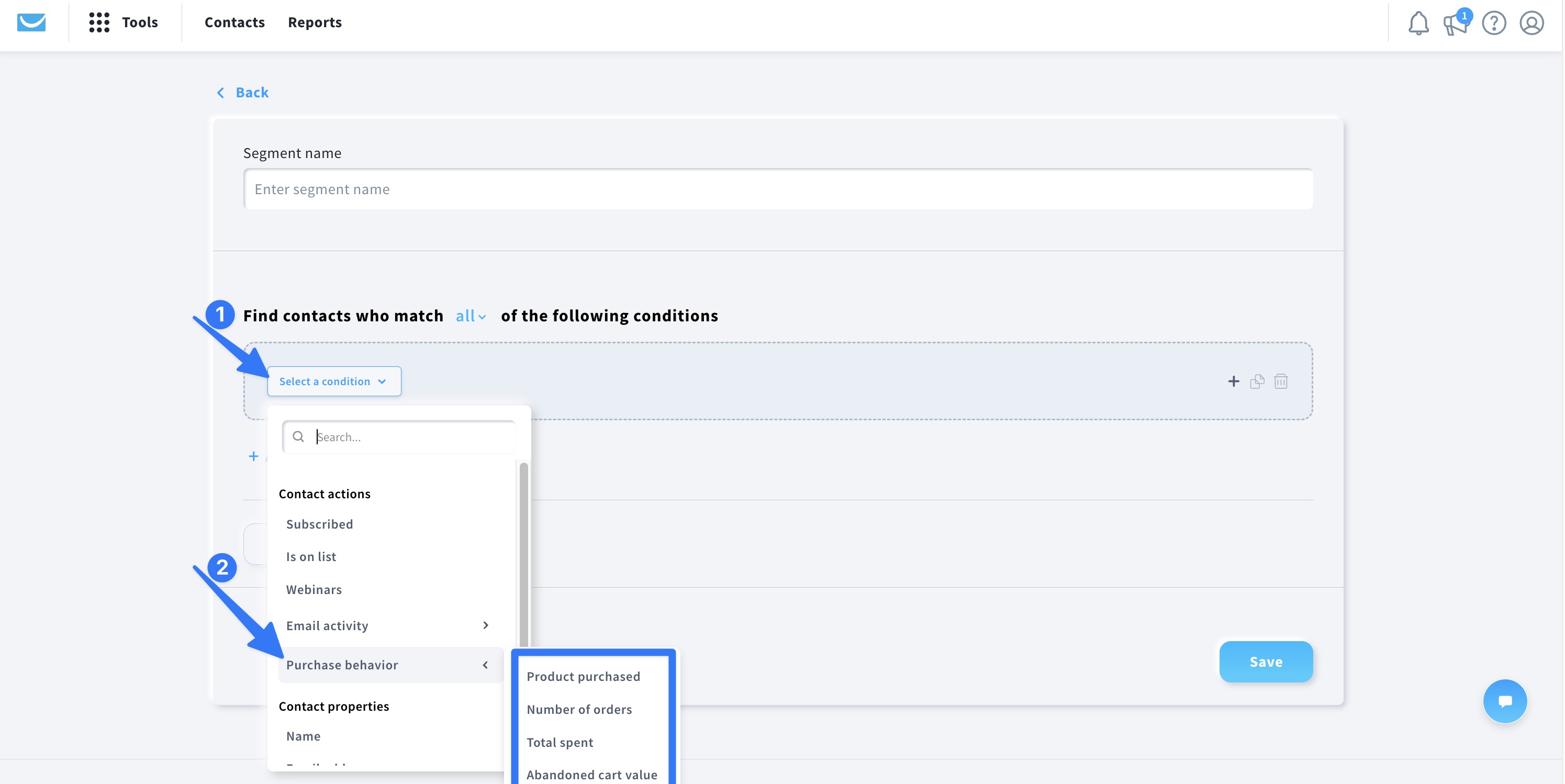
What ecommerce conditions can I use
The conditions you can segment your contacts by include:
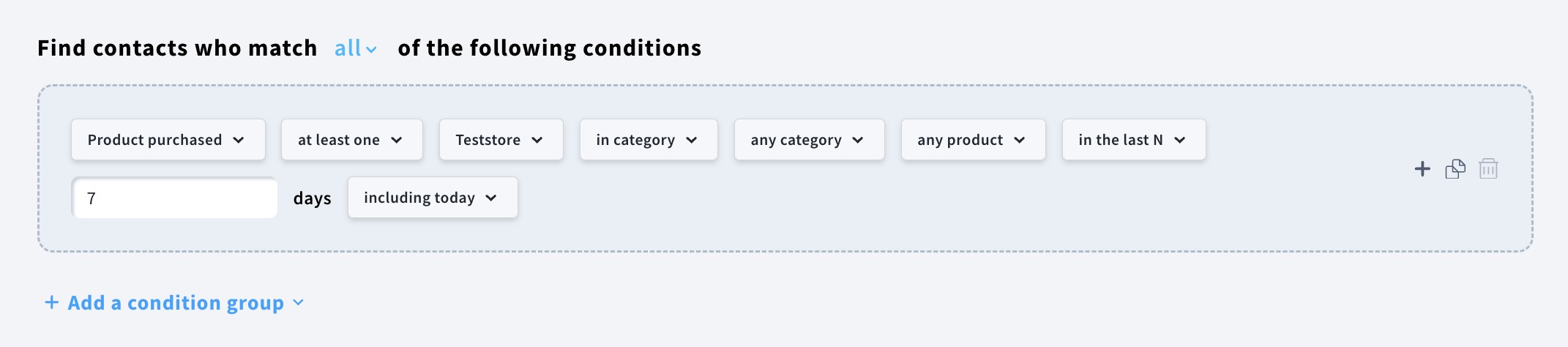
Product purchased
Use this condition to find contacts based on the products they buy. You can define whether contacts should have purchased at least one product or no products at all, depending on your goal. You can then define the criteria as broadly or as precisely as needed by selecting the store, brand, category, or specific product. You can also specify the time frame (for example, within the last few days, before or after a date, or between selected dates) to focus on when the purchase activity happened.
Number of orders
Use this condition to find contacts based on how many orders they’ve placed. You can define the store and set a numeric condition to match your segment, using comparisons such as greater than, less than, equal to, or other variants against a chosen value. You can also refine the results by selecting a time frame to focus on orders placed within a specific period.

Total spent
Use this condition to find contacts based on their total purchase value. You can define the store and set a spending amount using comparison logic such as greater than, less than, equal to, or other variants, along with the relevant currency. You can also refine the results by selecting a time frame to focus on spending within a specific period.

Abandoned cart value
Use this condition to find contacts based on the value of their abandoned carts. You can define the store and set a cart value using comparison logic such as greater than, less than, equal to, or other variants, along with the relevant currency. You can also refine the results by selecting a time frame to focus on cart activity within a specific period.

What pre-built ecommerce segments can I use
If you don’t want to create a segment from scratch, you can use pre-built segments to quickly find common groups of contacts based on their purchase behavior.
To use a pre-built segment:
- Scroll down and click on the Sales & revenue category to display ready-made ecommerce segments.
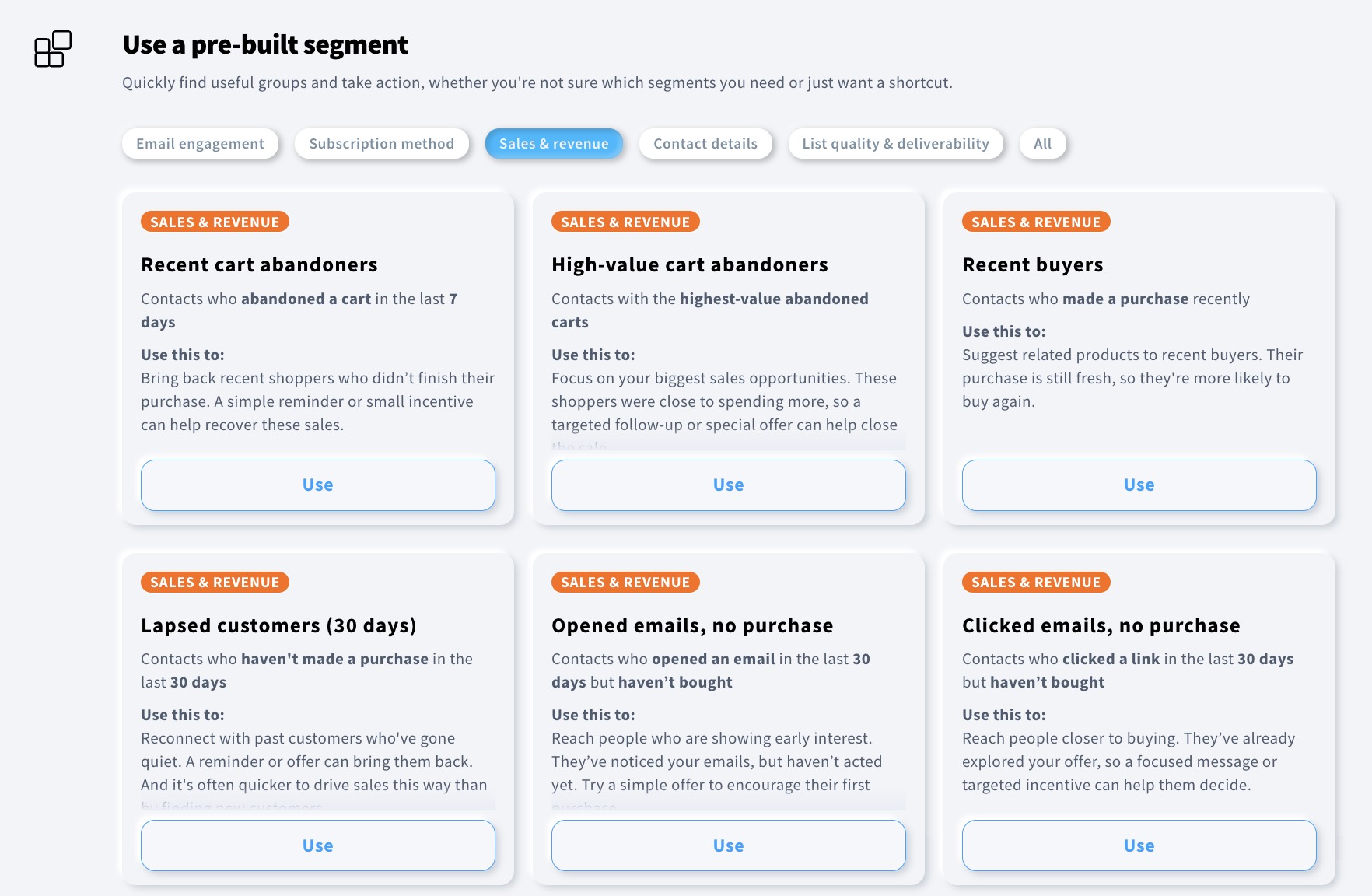
- Click Use next to the segment you want to apply.
- In the popup, select the store and click Continue.
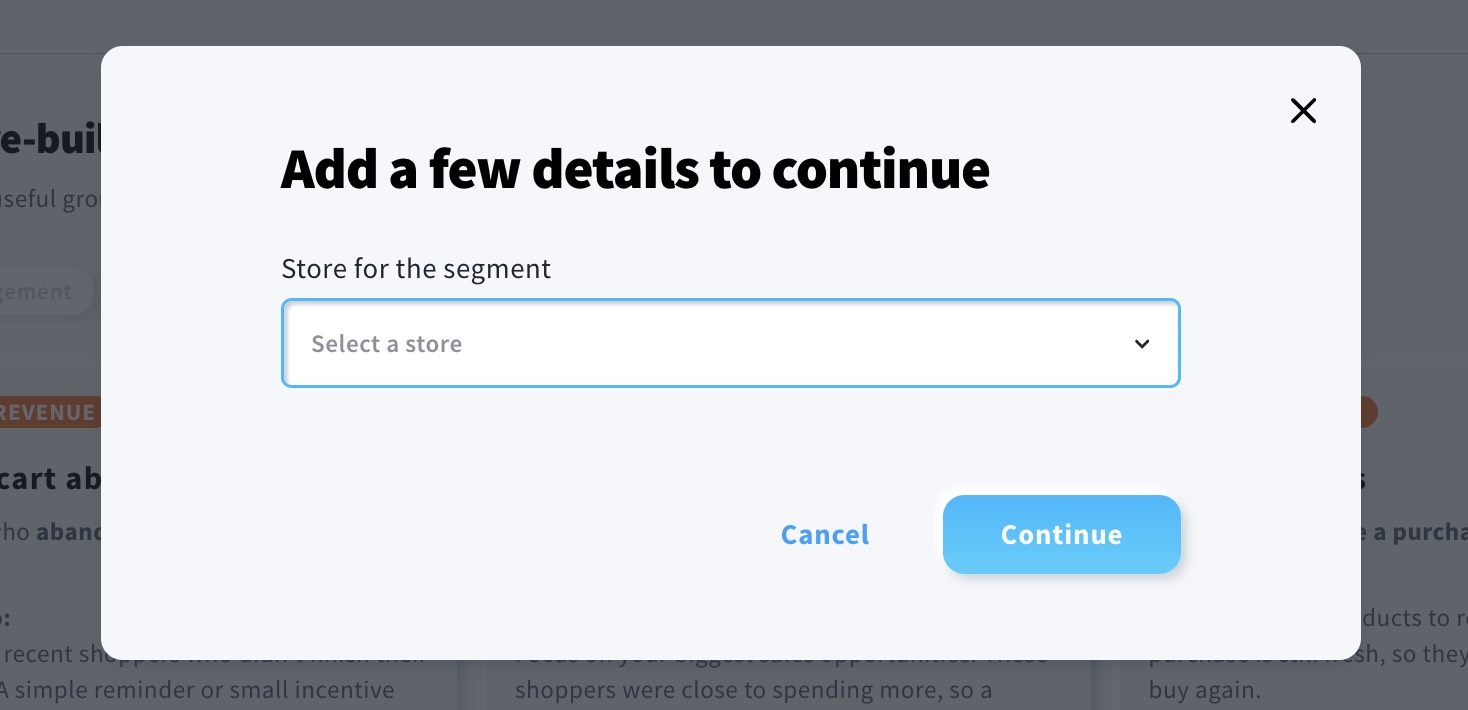
- You’ll then be taken to the segment editor, where you can set the segment name, adjust conditions if needed, and save it.
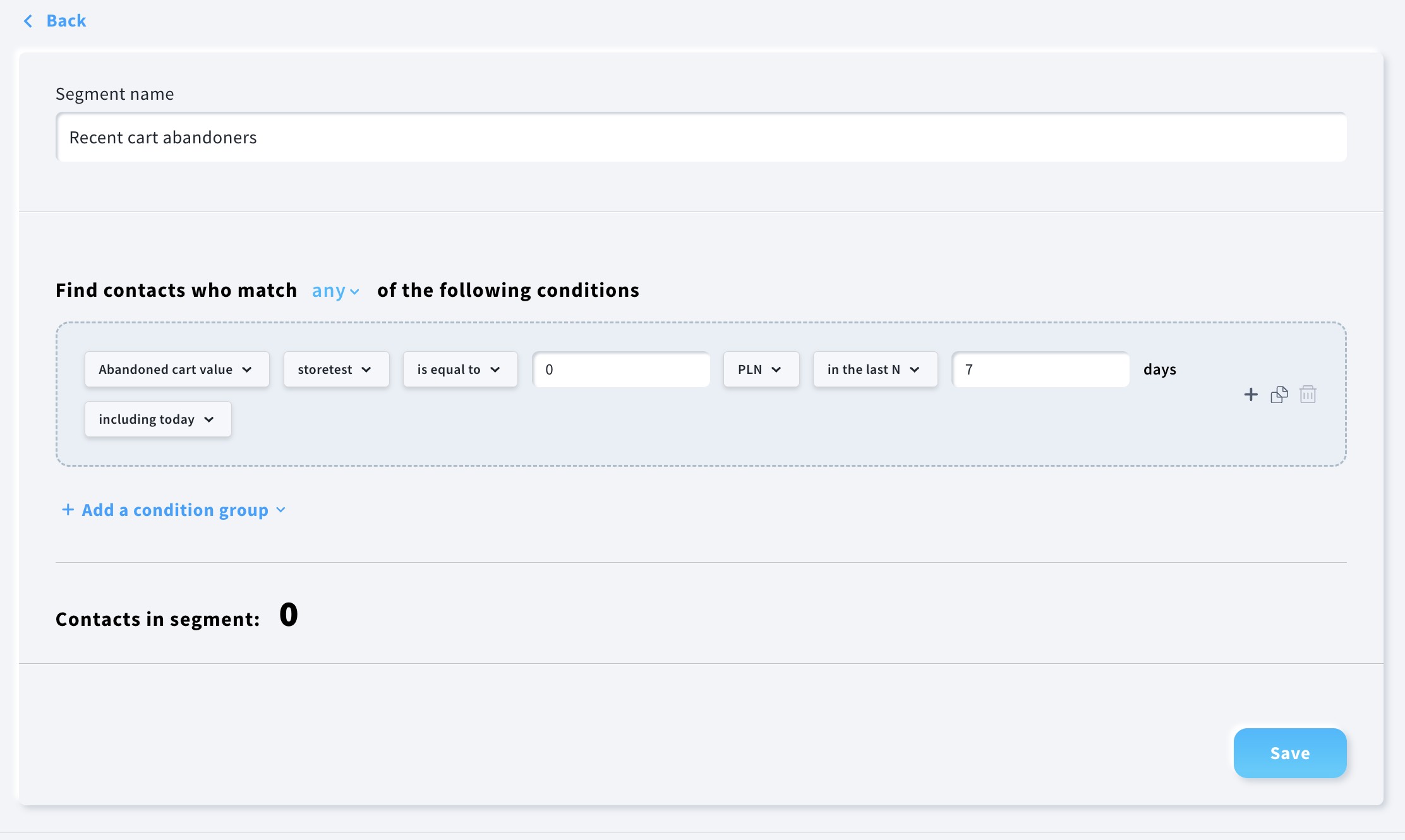
The available pre-built segments include:
- Recent cart abandoners – contacts who abandoned a cart in the last 7 days
- High-value cart abandoners – contacts with the highest-value abandoned carts
- Recent buyers – contacts who made a purchase recently
- Lapsed customers (30 days) – contacts who haven’t made a purchase in the last 30 days
- Opened emails, no purchase – contacts who opened an email in the last 30 days but haven’t bought
- Clicked emails, no purchase – contacts who clicked a link in the last 30 days but haven’t bought
- Bought specific product – customers who bought a specific product
- Bought from a category – customers who bought products from a specific category
- Buying but not opening emails – customers who made a purchase but aren’t opening emails
- High-spending customers – customers whose purchase value is above average
- Repeat customers – contacts who’ve made more than one purchase
- One-time customers – contacts who’ve made only one purchase
- New customers (recent) – contacts who recently made their first purchase
You can use these segments as they are or adjust their conditions to better match your needs.
What can I do with the ecommerce filters
Once you’ve filtered your contacts, you can save your search as a segment to create a group of message recipients for targeted mailing. You can also use segments in Marketing Automation. Learn more about how to create and use segments.
For example, say you have an online store selling books. You then decide to reward the most loyal customers by sending them a free ebook.
You can use the segmentation function to first locate the most loyal customers, for example, by using the filters for Number of orders or Total spent. You can decide to look for customers who’ve bought more than 4 books from you or those who’ve spent over $100.
Once you locate those customers using the search filters, you can then save them as a segment and create a newsletter with a link to the free ebook. You can then send this message to this specific group, using the segment you’ve created.
Steps for legacy segmentation
To find and segment your contacts:
- Go to Contacts>>Search.
- Click Advanced search.
- Click Add condition.
- In the drop-down menu, select Ecommerce.
What Ecommerce conditions can I use?
The conditions you can segment your contacts by include:
Number of purchases
Select this condition to find contacts who’ve made a certain number of purchases from all stores or a specific store. For example, you can use this option if you’re looking for:
- repeat customers

or
- customers who have never returned to your store after one purchase

Total spent
Use this condition to find contacts who’ve spent a certain amount of money in one or all of your stores. Enter the amount, select the currency, and specify if you’re looking for people who’ve spent the exact amount or more or less than that amount.
Product purchased
Use this condition to find contacts based on products they buy. You can choose how broad or specific you want the criteria to be:
- search in all stores or a specific store
- search in any category or a specific category
- search within products bought any time or within a specific time frame
- use the “is” and “isn’t” operators to specify if you’re looking for people who have or haven’t bought a specific product
For example, you can use this search option to find recent customers who have purchased a specific product from a specific category in a specific shop.
Brand purchased
Use this condition to find people who have or haven’t bought a product from a specific brand in your store.
What Conversion funnel conditions can I use?
You can use search conditions to filter specific contacts from Conversion funnel. To find and segment those contacts:
- Go to Contacts>>Search.
- Click Advanced search.
- Click Add condition.
- In the drop-down menu, select Conversion funnel:

The conditions you can segment your contacts by include:
Order history:
Use this condition to find people who have:
- Completed transactions
- Incomplete transactions
- Any status

Total spent:
Use this condition to find people based on how much money they spent.
Abandoned order:
Use this condition to find people who abandoned their order.
What can I do with the ecommerce filters?
Once you’ve filtered your contacts, you can save your search as a segment to create a group of message recipients for targeted mailing. You can also use segments in Marketing Automation. Learn more about how to create and use segments.
For example, say you have an online store selling books. You then decide to reward the most loyal customers by sending them a free ebook.
You can use the segmentation function to first locate the most loyal customers, for example by using the filters for Number of purchases or Total spent. You can decide to look for customers who’ve bought more than 4 books from you, or those who’ve spent over $100.
Once you locate those customers using the search filters, you can then save them as a segment, and create a Newsletter with a link to the free ebook. You can then send this message to this specific group, using the segment you’ve created.


